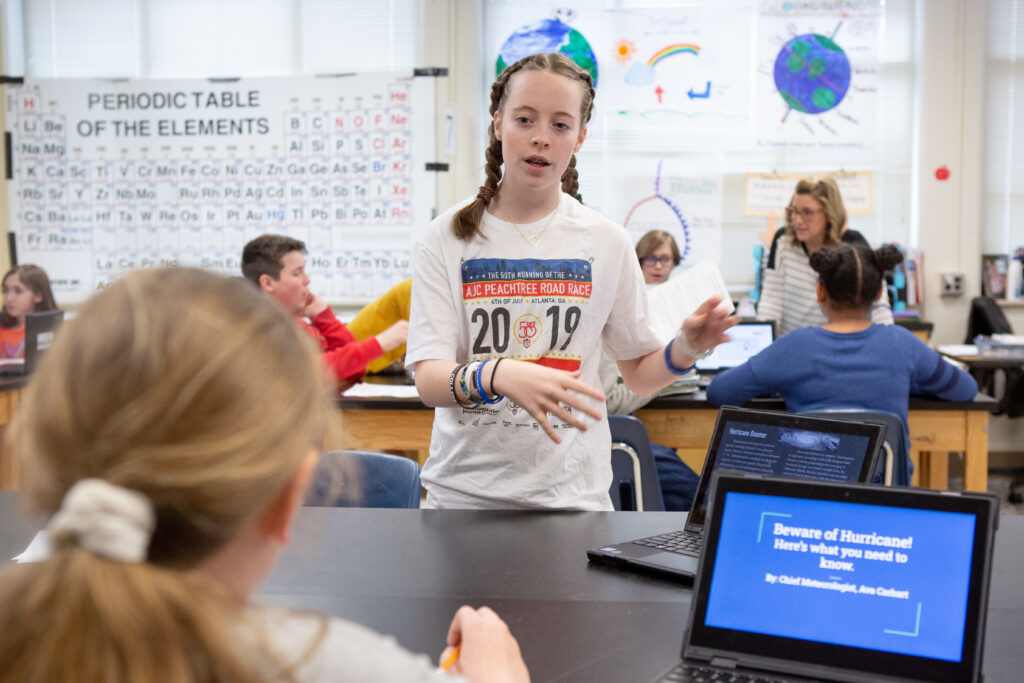


At FullScale, we have seen firsthand the positive impact that community schools have on their students and communities. Over the past two years, we have been learning from community schools across the country, highlighting the thoughtful, interconnected ways they support their students and communities. These schools are doing important work: setting up local work-based learning opportunities for students, providing ESL classes to parents, offering free back-to-school clothes to kids whose families can’t afford it, connecting local retirement communities to elementary schools to support students in reading, and so much more. These schools ensure they are meeting students’ needs and celebrating their gifts, allowing students to show up and learn to the best of their ability.
Yet last week, the U.S. Department of Education cut funding to community schools across the country. At least a dozen recipients of grants from the Full-Service Community Schools program learned that they would stop receiving funding this month, unless they submit a successful appeal within a week.1 In the letters grantees received, the Trump administration official Murray Bessette wrote that “the grant is inconsistent with, and no longer effectuates, the best interest of the Federal Government and will not be continued.”2
The Full-Service Community Schools program “provides support for the planning, implementation, and operation of full-service community schools that improve the coordination, integration, accessibility, and effectiveness of services for children and families, particularly for children attending high-poverty schools, including high-poverty rural schools”.3 Cutting funding from these schools means the loss of vital support services that help meet kids’ basic needs and support their learning–things like food pantries, back-to-school clothes, and job training programs. These cuts will do real harm.
Although the full list of grantees losing funding is not yet public, affected programs are beginning to share the impact on their work. One grantee, located in rural Idaho, reported that their grant supports 47 community schools across the state, and pays the salaries of coordinators who connect families in need with local resources. This includes services like a food pantry, free clinic, tax assistance, and even a partnership with the Idaho Department of Labor to help parents find jobs.4 The abrupt loss of their funding endangers those essential services and connections.
We know that achieving “excellence in education” requires students to be supported as whole people. Students cannot learn effectively if their basic needs are unmet. These needs are simple: things like food, clothing, social stability, health, and a sense of belonging. These needs must be addressed before students can focus on learning in school. But too often they are not: for example, 1 in 5 children across the US don’t have enough to eat.5
Community schools are an evidence-based and highly effective approach to improving not just student learning, but overall student outcomes, particularly for historically marginalized groups. At their core, community schools offer a whole-child approach to learning that addresses students’ needs and embeds learning in local communities. In fact, decades of research have proven the impact of community schools, with positive outcomes including:
- More students showing up: Significant improvements in attendance and chronic absenteeism, and reductions in dropout rates6 and suspension rates7
- Improved academic mindsets for students: Increased academic confidence and more positive attitudes about school 8
- Improved academic outcomes: Improved test scores7 and increased graduation rates6
- Increased family partnership: Increased parental involvement and communication with school staff
- Improved student well-being: Increased access to physical and mental health services, improvement in self-esteem for students receiving school-based mental health services
FullScale will continue to spotlight the important work of community schools, including those impacted by these funding cuts, and advocate for all schools to serve their students fully. We call on the Trump administration to restore this vital funding and help schools meet the basic needs of their learners so that all kids can thrive.
References:
- 1 EdSource
- 2 EdWeek
- 3 US Department of Education
- 4 Idaho News
- 5 Feeding America
- 6 ICF International. (2010). Communities In Schools National Evaluation: Five Year Executive Summary.
Communities in Schools.
https://www.communitiesinschools.org/media/uploads/attachments/Communities_In_Schools_National_E
valuation_Five_Year_Executive_Summary.pdf - 7 Swain, W., Leung-Gagné, M., Maier, A., & Rubinstein, C. (2025). Community Schools Impact on Student
Outcomes: Evidence From California. Learning Policy Institute.
https://learningpolicyinstitute.org/product/ca-community-schools-impact-student-outcomes-report - 8 Flynn, M. (2021). Schools and Communities Working Together: Features and Impacts of Community Schools.
Penn State Social Science Research Institute.
https://evidence2impact.psu.edu/wp-content/uploads/dlm_uploads/2024/01/Community-Schools_FINAL.p
df - 9 Blank, M. J., Melaville, A., & Shah, B. P. (2003). Making the difference: Research and practice in community
schools. Coalition for Community Schools. https://files.eric.ed.gov/fulltext/ED499103.pdf - 10 Weist, M. D., Paskewitz, D. A., Warner, B. S., & Flaherty, L. T. (1996). Treatment outcome of school-based
mental health services for urban teenagers. Community Mental Health Journal, 32(2), 149–157.
https://doi.org/10.1007/BF02249752