
Students don’t usually announce they’re experiencing competency-based learning.
Instead, it surfaces in small moments.
A student asks whether they can demonstrate a writing competency in another course using the same performance criteria. Across the hall, students working on the same engineering project are at different stages of construction, each moving forward only after demonstrating readiness. Nearby, a student describes how they developed skills in research, collaboration, and time management across several projects, connecting their learning to a common set of competencies rather than a single assignment.
Individually, these moments are easy to overlook. Together, they suggest that schools using competencies are doing something more than organizing curriculum or grading. They’re shaping how students make decisions, connect learning, and demonstrate what they know.
Over the past two decades, researchers, practitioners, and policymakers have deepened our understanding of competency-based learning by studying school models, instructional practices, and the systems that support them. Yet comparatively little attention has focused on how those systems become visible through students’ day-to-day learning experiences. This gap has led us to ask:
What can we learn from student experiences in competency-based learning?
From a National Landscape to Student Experiences
This spring, FullScale published a landscape scan of 106 high schools across nearly 30 states implementing competency-based learning and related approaches.
To guide that work, we developed a set of hypothesized markers of competency-based learning based on existing research, frameworks, and learning agendas. We then used those markers as a lens for examining how schools nationwide describe and design competency-based learning systems.
Our current study builds on that work by asking where—and how—those markers become visible in students’ everyday learning experiences.
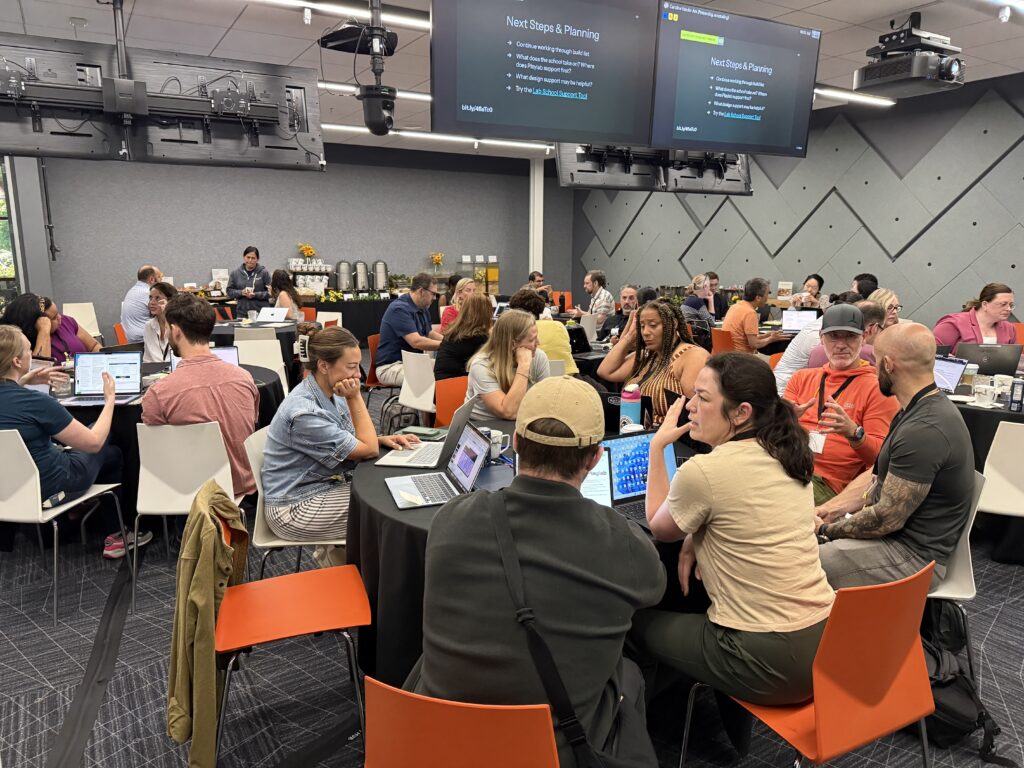
To begin exploring these questions, our research team visited 10 high schools who are deeply engaged in competency-based learning during the spring of 2026, conducting 49 classroom observations and observing more than 1,000 students engaged in learning.
FullScale’s National Study on Competency-Based Learning Features 10 High Schools
- Bismarck Public Schools Empower[Ed] (North Dakota)
- Clark Street Community School (Wisconsin)
- Compass Community Collaborative School (Colorado)
- Crosstown High (Tennessee)
- Da Vinci Communications (California)
- Del Lago Academy – Campus of Applied Science (California)
- Harwood Union High School (Vermont)
- Lindsay Senior High School California)
- Northern Cass School District (North Dakota)
- STEAM Academy (Kentucky)
Where Competencies Became Visible
As we moved through classrooms, we weren’t looking for a particular instructional model or classroom structure, but rather evidence of how competency-based learning was being enacted and experienced at the student level.
Sometimes that evidence appeared as students revised their work in response to feedback. Sometimes it emerged through authentic applications of learning. Other times, it surfaced in the connections students made across their learning in and out of school.
Competencies became visible through iteration.
| Marker Spotlight: Iterative Purpose The extent to which the learner seeks adult and peer feedback before final submission, iterates through drafts or attempts, and requests targeted feedback to support mastery of competencies. |
In STEAM Academy’s engineering classroom, students were constructing chairs from cardboard that could hold their teacher’s weight. As they assembled the pieces, one group realized several sections no longer aligned. They returned to their measurements, replayed portions of an instructional video, compared dimensions, and questioned one another as they searched for the source of the problem. After identifying inconsistencies in pieces they had already cut, they adjusted the remaining measurements, tested the revised design, and continued building.
Rather than moving directly from assignment to completion, students treated feedback, testing, and multiple attempts as expected parts of learning. Progress depended not on finishing first, but on using evidence from each iteration to improve their work before attempting to demonstrate proficiency of the related competency.
Competencies became visible through authentic application.
| Marker Spotlight: Rigorous Application of Learning The extent to which the learner produces authentic, contextually meaningful work products that serve as demonstrations of mastery aligned to competency progression criteria. |
In one of Clark Street Community School’s interdisciplinary classes, students investigated natural disasters they had chosen to study. Rather than working through a common set of problems, each student developed a mathematical model to answer a self-selected question using publicly available National Oceanic and Atmospheric Administration (NOAA) datasets.
As they worked, students refined both their analyses and the products they were creating. One student narrowed an earthquake dataset after feedback from their teacher to better support the original research question. Nearby, another compared tornado patterns across the state, designing a visualization modeled after the structure of a scientific journal abstract.
These learning experiences did not emphasize arriving at a correct answer. Students were creating authentic work products that required them to apply mathematical concepts, make decisions about evidence, and communicate their reasoning. Those products became demonstrations of learning, providing evidence of increasingly sophisticated understanding as students progressed toward competency.
Competencies became visible through connections across learning.
| Marker Spotlight: Clear Articulation The extent to which the learner organizes school and lived experiences around cross-cutting competencies. |
During independent project work in a class at Del Lago Academy, the day’s agenda outlined the week’s progression alongside the academic standards and competencies students were developing. Project materials described not only what students were doing, but why, connecting each activity to broader learning goals.
As two students discussed their projects, one paused and reflected, “This reminds me of another class, where I had to interpret what happened in a video, and then explain it from my point of view.” Their conversation continued as they compared experiences across courses and recognized that they were developing similar ways of thinking and communicating in different settings.
The competencies themselves were never the focus of the conversation. Instead, they provided a shared framework for organizing learning across classes and experiences. Rather than viewing school as a series of disconnected assignments, students were making sense of their learning through competencies that carried across courses and extended beyond the classroom.
This Is Just the Beginning
The classroom observations represent the first phase of our current study.
Over the coming months, we’ll bring together classroom observations with surveys, focus groups, interviews, and additional sources of evidence to better understand student experiences alongside the school and policy conditions that shape them.
We’ll share our findings at the FullScale Symposium and continue the conversation during our pre-conference session, where we’ll explore classroom stories, study findings, and what they suggest for schools and policymakers working to strengthen competency-based learning.