
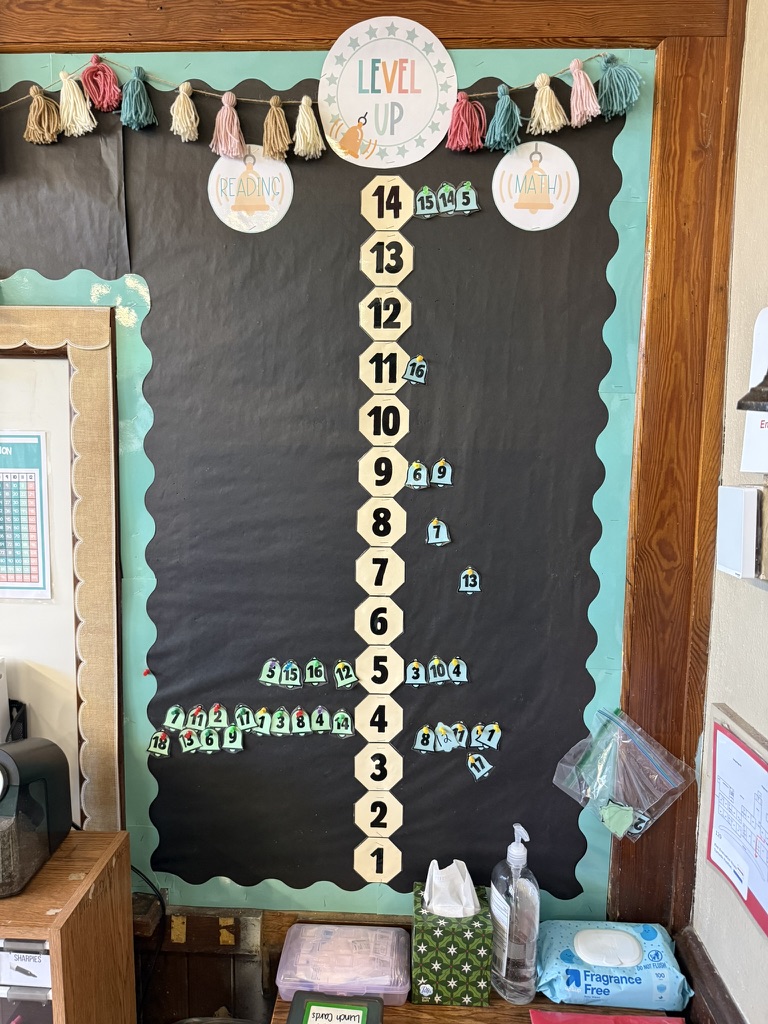
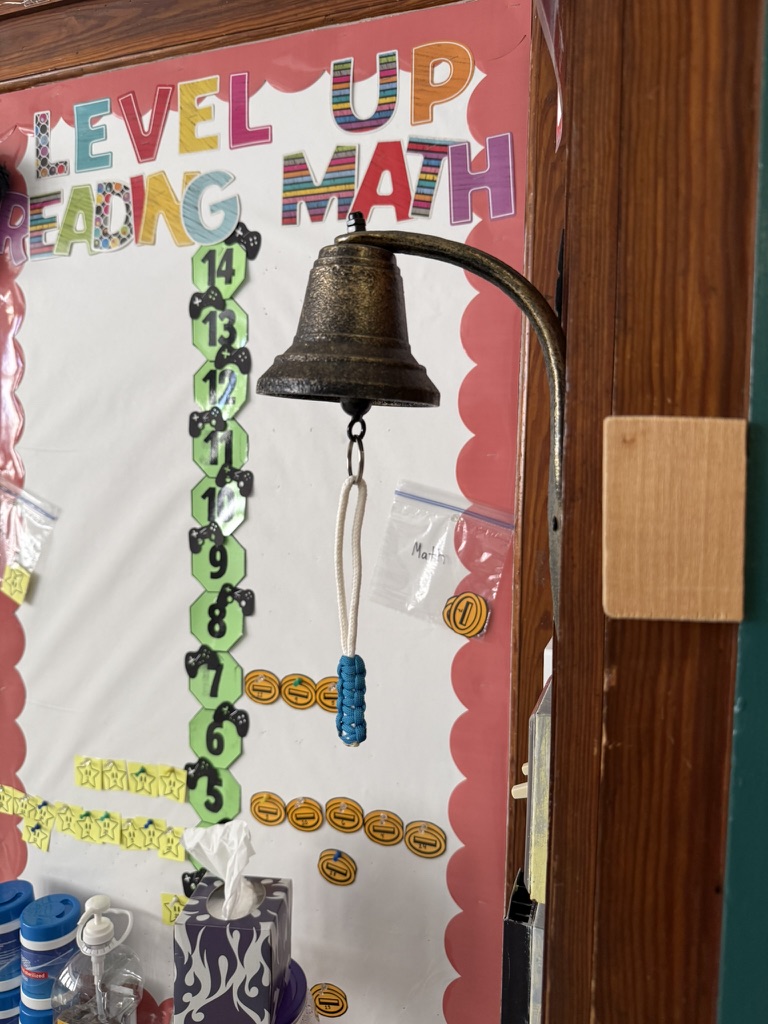
Walking through Morgan Elementary, it quickly becomes clear that learning is organized differently here. On every classroom wall is a colorful progress chart, where students are marking their movement towards mastery. Each time a student masters a new skill, they get to ring a bell, to the cheers of their fellow students. Students and teachers alike speak with enthusiasm about the culture and pride associated with the bell ringing. For example, one young student said he feels “happy and proud” when he rings the bell in his classroom after mastering a post-test. A parent described the experience of her son saying, “He gets excited when he comes home and says, ‘Mom, I rang a bell today! I did this!’” Teachers also speak with deep fondness of the tangible representation of their student’s learning progressions, and how hearing that bell ring out makes the journey to CBE worth it. In the words of one educator: “The biggest pull was seeing how excited kids got when they got to ring that little bell in the classroom when they showed mastery… Those challenges [along the way] seem like a blur and a distant memory.”
This approach, and the culture of celebration and delight in learning that accompanies it, did not begin as an abstract commitment to competency-based education. It also did not emerge overnight or through a single PD session. It emerged from a practical question facing school leaders and educators: How do we stop moving students forward before they’re ready, while also ensuring they stay connected to their peers and school community?
Over time, Morgan has built a learning system that responds to that challenge by prioritizing mastery over pace, clarity over compliance, and support over sorting. Morgan’s approach reflects a deliberate shift away from time-based schooling and toward a competency-based system designed to ensure all students can reach high expectations with the time, support, and flexibility they need. As an elementary school, Morgan offers an especially compelling example of how competency-based education can be implemented early, before gaps widen and learning identities harden, while still preserving the stability and relationships young learners need.
As we described in our opening post for this series, there are seven key elements that define competency-based education. These are:
- Essential competencies
- Equitable culture, structure, & pedagogy
- Student agency
- Meaningful assessment
- Responsive pacing
- Personalized pathways
- Timely differentiated support
The sections that follow examine how Morgan Elementary enacts each of these principles through concrete structures, daily instructional practices, and a schoolwide commitment to equity and student growth.
Essential Competencies
Rigorous, common expectations for learning (knowledge, skills, and dispositions) are explicit, transparent, measurable, and transferable. (Aurora Institute)
At Morgan, competencies are not treated as an abstract “portrait of a graduate” document sitting on a shelf. They are translated into a small, navigable set of learning targets that structure what students work on, how teachers plan, and how progress is tracked across time. The school has intentionally reduced complexity for students by consolidating the North Carolina standards into proficiency scales so learners aren’t trying to decode dozens of disconnected objectives at once. The result is a learning system where expectations are more consistent and progress is easier to communicate—within classrooms, across grade levels, and with families.
Morgan’s proficiency scales group related content standards together. Proficiency scales have three statuses: near mastery, mastery, and exceeds mastery. Proficiency scales describe concretely what students need to know and be able to do; all students are expected to achieve at least “mastery” status on all of the proficiency scales in their current level. [Artifact of a proficiency scale]
Every student at Morgan is well-versed in the scales, and carry student-friendly versions in their “Bronco Binders”: notebooks that house data tracking, classwork, and family communication. As students progress through a scale, they are able to self-assess and track their mastery through “I can” statements.
Morgan’s essential competencies also include the skills and dispositions needed to thrive as a member of a learning community, known throughout the community as interpersonal skills. As described in more detail in our previous post, the school community focuses on developing one skill each month, with explicit instruction through classroom community meetings and counselor-led lessons. Students also track their progress in demonstrating these skills on a rubric in their Bronco Binder.
Taken together, these academic and interpersonal competencies create a shared language for learning across the school. By making expectations explicit and progress visible, Morgan has built a foundation that allows pacing, assessment, and support to flex without losing coherence or rigor.
Student Agency
Students are empowered daily to make important decisions about their learning experiences, how they will create and apply knowledge, and how they will demonstrate their learning. (Aurora Institute)
While Morgan does use some of the more common student agency strategies like choice menus, what makes the school unique is how students are learning to see themselves as learners with trajectories—people who can identify what they need, ask for support, and persist through challenges.
Students describe being able to move at their own pace, get individualized help, and use tools and routines that help them make decisions about their learning day. According to students, agency shows up in small but meaningful examples: selecting reading material for homework, using adaptive reading platforms, and revisiting spiral review items when they need more practice—choices that reinforce ownership rather than compliance.
Meaningful Assessment
Assessment is a meaningful, positive, and empowering learning experience for students that yields timely, relevant, and actionable evidence. (Aurora Institute)
At Morgan, assessment is used to organize instruction, motivate students, and normalize revision and support.
Assessment is also iterative. Students can take a pre-test to see what they already know and can do, receive instruction and practice a skill, take another assessment to see what they’ve learned so far, get additional support from their teacher, and then try again to see how they’ve grown. Students take what they call “post-tests” after getting help and instruction—language that suggests assessment is treated as an opportunity to demonstrate learning after support, not simply a one-and-done judgment.
From the educator perspective, the value of this approach to assessment shows up most clearly in planning. Teachers described how proficiency-based grouping and progress monitoring make instructional planning more precise. Instead of trying to “cover” a lesson and then scramble afterward to support students who didn’t get it, teachers can plan proactively because they have sharper clarity on who needs what and when.
This approach to assessment helps build students’ dignity and confidence, and reinforces the culture of ongoing learning at the school. Assessment becomes less about ranking students by grades, and more about providing information on learning progress. It tells teachers where to lean in, tells students what to work on next, and allows progress to be celebrated in ways that build confidence rather than comparison.
Responsive Pacing and Personalized Pathways
Students progress based on evidence of mastery, not seat time; students learn actively using different pathways and varied pacing. (Aurora Institute)
Morgan’s pacing model is a clear illustration of how an elementary school can enact competency-based learning while still preserving stable classroom communities. Students are placed in levels that correspond to their age, but their learning is tied to proficiency scales which may not match their age level. In fact, students can advance to the next level as soon as mastery is demonstrated—at any point in the year. In fact, instead of the typical “first grade, second grade, third grade” nomenclature, Morgan refers to each complete set of standards-aligned competencies as a “level.” Rather than identifying as a “third grader,” a student might say, “I’m in Level 3,” indicating they are working on competencies aligned with third-grade standards.
This is not a minor scheduling tweak; it’s a philosophical shift. The school explicitly rejects the idea that “180 days equals readiness.” Instead, it treats learning as a continuum across years, with a promise to families that students will begin the next year where they left off academically, rather than being reset to a new curriculum sequence just because summer happened.
To make this student-friendly and support students’ agency and motivation, Morgan has developed a fun way of helping students monitor their own progress. Each classroom features a number line that makes learning progress visible across the proficiency scales. Students are represented by numbers instead of names, reinforcing a culture where progress is transparent but sharing is optional and student-owned.
You can see the impact of that clarity in how students talk about learning. Learners describe how “at all times we know exactly where we are” and are able to name what they need help with—language that signals they understand learning as a progression rather than a set of tasks to complete for a grade.
Students can be in different levels for math and ELA, depending on the competencies they are currently working on. Students typically spend their days with same-age peers, reinforcing that it’s fine for everyone to be learning at their own pace. At times, students will move to different rooms to join small, heterogeneous groups targeting a specific scale within their level. These groups can be multiage, but there is no stigma associated with being in different rooms or at different levels.
When asked whether there are competitive feelings between friends on different levels, one student shared, “Well, I don’t want to make people feel bad that they’re at a lower level than me., but I don’t want them to stop learning. I think that it’s good for them to feel that even if their friends might be at a different level, that’s okay because they can go at their own pace and it might influence them to try to reach their goal.”
That sense of stigma-free collective ownership and pride over everyone’s learning is visible each time a classroom bell is rung when a student has mastered a scale. The entire class erupts in claps and cheers, celebrating the learning of their peers–something that can happen at any time, given that students are progressing at different paces. The celebration spills into the halls and into the community. Students receive a sticker showing they have mastered a scale so all of Morgan–and beyond–can join in the celebration.
One parent (who is also a teacher) shared her daughter’s experience, highlighting the community culture of honoring each student’s learning journey: “My daughter walks down the hall after ringing the bell and every single teacher that sees the sticker will say ‘Oh, good job. Wonderful job.’” Every student that sees it says ‘Oh, you rang the bell, that’s awesome.’ So it’s not just contained within our classrooms, it’s promoted throughout the whole school. And then when these kids wear it out in the community, people might ask, ‘Hey, what’s that for?’ and students will respond, ‘Oh, I rang the bell. I passed one of my math skills.’ Or ‘I rang the bell, I passed one of my reading clusters’ and they get to celebrate that with everyone.”
The school also holds three schoolwide bell-ringing ceremonies each year to celebrate students who have moved up a level. The community gathers around a large bell hanging outside to listen to the chimes of students who have “leveled up.” When asked whether students ever feel badly about not leveling up, teachers shared that it is not a matter of if a student will ring the big bell, but when. Students understand that if they do not ring it at one ceremony, they will ring it at a future one—reinforcing that progress is expected, individualized, and always within reach.
In order to support students on their differing paths and timelines to mastery, teachers intentionally make instructional design choices that create multiple routes to the same goals. In addition to students having options for how they learn in their daily classroom experiences, the school also intentionally provides experiential learning days that give students another way to learn. These “Discovery Days” are schoolwide themed days that intentionally explore academic standards through a high-engagement context. One teacher described a Discovery Day with a NASCAR theme, where students explored concepts like force and motion through experiments and demonstrations connected to cars and racing. These experiences don’t replace core instruction; they deepen and contextualize it. They also create shared reference points that make academic ideas stick, and support students in their personalized paths towards mastery of their learning.
Timely Differentiated Support
Students receive timely, differentiated support based on their individual learning needs. (Aurora Institute)
A flexible system like Morgan’s only works if students are not left to navigate it alone. At Morgan Elementary, differentiation and personalized support are not occasional interventions for students who need additional support, but rather part of the school’s “business as usual” for all learners.
Students described teachers meeting with them personally, helping them with what they need, and ensuring they can re-approach learning when they’re ready. Teachers described how grouping and progress monitoring reduce guesswork: they can focus on what each group needs, push students who are ready for more challenge, and provide targeted instruction without losing the whole classroom’s momentum.
In addition to the personalized and small-group support provided by teachers, Morgan Elementary has also reached out to its community to help operationalize this principle. The school hosts many volunteers, including a group from a local retirement community, who work with students for one-on-one support and tutoring. For Discovery Days, the school also taps local professionals or hobbyists to come share their expertise. This kind of community-connected learning helps expand learning opportunities without requiring an entirely separate program structure.
And this differentiated support is not limited to academics. School leaders described how being community-centered helps the school understand students’ needs holistically—social, emotional, physical, and academic—and mobilize community resources accordingly.
Equitable Culture, Structure, and Pedagogy
Strategies to ensure equity for all students are embedded in the culture, structure, and pedagogy of schools and education systems. (Aurora Institute)
CBE systems succeed or fail based on whether equity is designed into the structure—not added later as an intervention. Morgan’s equity work is visible through their commitment to making sure every student has what they need to be successful in learning. in two intertwined commitments: meeting students’ foundational needs and refusing to let time be the gatekeeper of opportunity.
As described in our previous post, the school has built an ecosystem of supports that removes common barriers to learning. Teachers and leaders described food supports that go home with students, winter coats distributed through school systems, and community events that connect families to learning resources (for example, a literacy-focused parent night paired with a family “bingo for books” event). These are not framed as charitable extras; they are treated as part of what it means to design an equitable learning environment.
One especially vivid example is Morgan’s back-to-school partnership model. Before school begins, the community funds a shopping trip for clothes, shoes, and supplies so every student has, in the words of Principal DiStefano, “the opportunity to be on a level playing field.” This intentionally sets a tone of belonging and readiness—reducing the inequities that show up on day one, long before academics come into play.
On the structure side, Morgan’s system is explicitly designed to interrupt one of the most common inequities of traditional schooling: students being moved on because the calendar turns, not because they have actually mastered the learning. This structure and pedagogical approach is core to how the school enacts its commitment to educational equity. Taken together, these cultural rituals and structural decisions reinforce one another. Equity at Morgan is not only about providing resources or adjusting pacing; it is about creating a school environment where belonging is protected, progress is individualized, and mastery–not time–determines advancement. By embedding these commitments into daily routines, public celebrations, and the very architecture of learning levels, Morgan ensures that equity is not an initiative layered onto instruction, but the foundation on which instruction rests.
Conclusion
Morgan Elementary offers a powerful illustration of what competency-based education can look like in an elementary setting when it is treated as a coherent system redesign rather than a collection of instructional strategies. Essential competencies are made visible through proficiency scales and shared learning language. Equity is reinforced through both structural decisions (mastery over time) and community partnerships that remove barriers to learning. Student agency is built through transparency, choice, and a culture that normalizes growth. Assessment informs action. Pacing is responsive and student pathways through unique are personalized. Supports are timely and routine. Morgan’s CBE system is not just helping students “move at their own pace.” It is building a school culture where progress is visible, support is expected and normalized, and students feel pride and motivation to learn.
Like other schools on this journey, Morgan’s story also reflects a deeper truth about CBE: the work is as much about trust and relationships as it is about design. Leaders described how shifting to this model required extensive family engagement and careful implementation—and how, over time, results and transparency helped strengthen community confidence in this new way of doing school. Their story speaks to the powerful and mutually reinforcing connections between competency-based and community schools approaches to serving all learners well.
