This interim research brief examines the keystone of LUSD’s Adult Learning Curriculum, known as Instructional Look Fors. The brief begins to explore if the Instructional Look Fors are a sound way of understanding the relationship between professional learning and learner achievement at LUSD. The initial data indicate that the majority of Instructional Look Fors are a measurable, reliable, and valid way for LUSD to understand the behaviors that are happening in learning environments and the relationships between professional learning, those behaviors, and learner outcomes. Download the executive summary or read the full report online; an accessible version of this report is also available for downloading.
This initial analysis of the impact of personalized professional learning on learner growth at LUSD addresses three primary research questions: (1) how did engaging in professional learning affect learner achievement?, (2) which combinations of professional learning emerged in terms of type and dose?, and (3) which combinations had the greatest effect on learner outcomes? The initial data confirm the need for multiple types of high-quality professional learning, the need for breadth and depth of those opportunities, and that there is no single pathway for all learners. Download the executive summaryor read thefull report online; an accessible version of this report is also available for downloading.
This research report examines the experiences of learners in a remote environment, investigating data collected on personalized learning following the shift to remote-only learning as a result of COVID-19 school closures. Researchers ascertained which learner and learning facilitator actions occurred most frequently in the context of personalized, remote learning and how these actions appeared across content levels. The report also provides implications and suggestions for district leadership to best prepare for future remote learning scenarios, with a focus on learner support and relationships, technology support, home learning environment support, and sustaining momentum for learning over time. Download the executive summary or read the full report online; an accessible version of this report is also available for download.
This cluster analysis employs a modular approach in presenting an in-depth analysis of the three-year Empower Teacher and School Leader (TSL) Grant, based on the findings from previous examinations of the professional learning program in LUSD. This research builds towards a broader examination of the personalized professional learning program and the performance-based compensation system (PBCS) implemented within the district. Download the full report, or view an accessible version online.
This tool, built off of Principle 8 from the Readiness for Reopening Guide, is intended to help teachers prepare their classrooms, taking into account cleaning and distancing procedures. It provides a daily guidance checklist identifying items that need to be cleaned regularly and the frequency of cleaning.
How do I develop mask-wearing as a cultural norm in my classroom? Mask-wearing is an important and evidence-based practice for reducing the risks of COVID-19 infection associated with the return to socially distanced, in-person learning. Teachers and leaders should build classroom and school-level cultural norms that support, reinforce, and celebrate mask-wearing as a critical habit for health as well as a commitment to caring for all school community members.
This report describes Vermont’s convenings to support schools, districts, and other education organizations seeking to create high-quality local comprehensive systems of assessments. It can serve as a resource for schools, districts, and states that are working toward improving their own assessment systems. Readers will learn about the rationale and essential components, formative and summative performance assessments, and student-designed performance assessments.
Local comprehensive assessment systems (LCAS) are essential for ensuring equitable learning opportunities for all students. They have the potential to ensure that each and every learner meets high expectations that are set across all content areas. The Vermont Agency of Education held convenings with educational leaders to refine tools and investigate resources that can improve local systems of assessments that support personalized, proficiency-based learning.
Fewer than one in five American students follow a clear and uninterrupted path from high school through college to career. The promise of a public education is to prepare all learners to engage in, contribute to, and achieve purpose in the world, both as it is today and as it will be tomorrow. And yet, the American education system as we know it is insufficient to realize this commitment.
The idea of a compulsory high school education was developed in the early 20th century, when the Commission on the Reorganization of Secondary Education proclaimed the purpose of secondary education to be “health, citizenship and worthy home-membership and, only secondarily, command of fundamental processes.” Education leaders designed the American high school system to ensure that 20 percent of students would be prepared for college, 20 percent for skilled trades, and that 60 percent of young people would be prepared for “life adjustments” to become fully American.
This paradigm’s time is up. Today, complex and compounding forces compel something more than incremental change in public education. Skyrocketing racial and economic inequality perpetuates generational poverty, predominantly for Black, Latinx, Indigenous people, demanding that education do more to create social and economic mobility. The future of work means that a person entering the workforce from low-income households today will likely work for six or more decades, during which time they will change jobs every four and a half years and “upskill” every five.3 Social changes and advances in technology push more and more learning outside of formal institutions, creating opportunities for dynamic learning ecosystems to take the place of linear, time-bound institutions of schooling.
Call to Action
This book issues a call to action for states to enact a Learner Promise: a commitment that every learner will have access and support to pursue a certified pathway with system-wide opportunities that guarantee entry into a meaningful, chosen career that will build social and economic capital over the course of their lives. Operating under this promise, states would enact systems of governance, policy, and infrastructure to certify that learners who demonstrate competencies in K-12, postsecondary, workforce, and community settings along a supported pathway will have access to continuing education and a purposeful, living-wage
career. States would commit to taking the systemic action necessary to disrupt inequities in access, engagement, and attainment for Black, Latinx, Indigenous people, and people from low-income households. And, states would reimagine education not as a linear, time-bound sequence of learning that occurs within institutions of formal education, but as a learning ecosystem. This ecosystem would be an equitable, dynamic, and responsive system in which learners can customize their learning experiences as they navigate experiences across schools, workplaces, and communities.
What might this system look like?
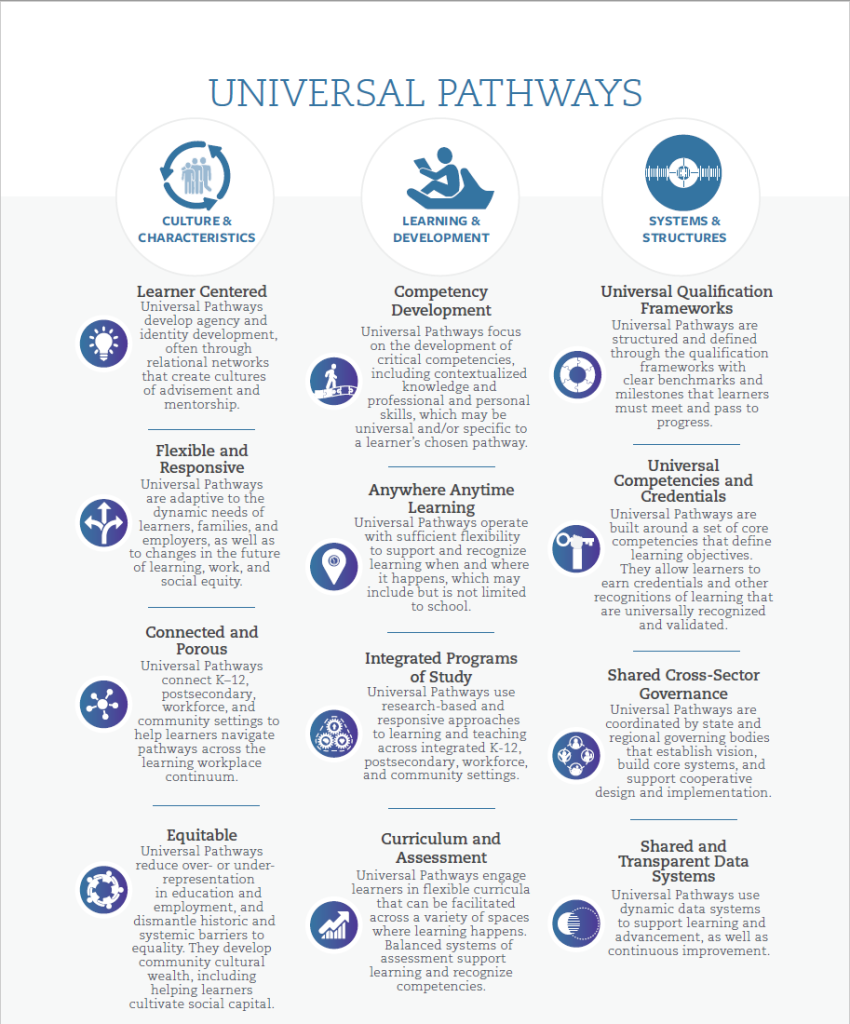
A system of universal pathways would articulate and certify multiple career pathways from K-12 through postsecondary education, career, and continuing education. Pathways would be transparent, universal, and recognized by schools and employers across the state. Each pathway would be defined by a progression of qualifying milestones and recognized credentials, which would certify that a learner has demonstrated a set of competencies across contexts and institutions on the basis of performance assessments. Coordination across K-12, postsecondary, workforce, and community would be enabled by a strong system of shared governance and dynamic, transparent data systems.
A system of universal pathways would focus on the development of critical competencies that support learners’ personal, professional, and academic development. It would recognize and support learning when and where it happens using balanced systems of assessment to evaluate and reward deep learning. It would prioritize cultural competency and align teaching with the learning sciences.
This self-assessment tool helps leaders assess current readiness and practice and then work with their teams and technical assistance partners to choose areas for highest impact.
This resource is intended to help school and district leaders understand, reflect upon, and prioritize actions to improve student learning in remote settings. This discussion guide highlights specific school-based “Power Moves,” examples and resources, and supportive system conditions that are particularly critical to ensuring high-quality teaching and learning in distance and online environments for all students.