
This is the second post in a series of three posts about Raíces del Saber Xinachtli Community School in Las Cruces, New Mexico. In post 1, we introduced the school. In post 3, we focus on their student-centered, competency-based learning approach. Check out the whole series!
I arrived at Raíces del Saber on the morning of my visit at the same time as students. Dropoff can tell you a lot about a school. It can be a chaotic time, with tensions running high, honking parents in a hurry to get to work, and children being herded indoors in an effort to create order. But at Raíces, none of that was happening. As cars wrapped around the school in an orderly line towards the dropoff area, students who were already inside the fenced-in playground waved eagerly at their friends. One little girl begged her mom to roll down the windows of their car so she could talk to her friend on the playground before she even got out of the car; her mom laughingly obliged. Students, staff, and families greeted each other warmly in an easy mix of Spanish and English, giving hugs and high-fives. As one little girl entered the school, the staff member at the door wished her a happy birthday, and her face lit up. “I’m 7 now!” she proudly proclaimed, giving the staff member a big hug.
When I asked family members about the school later in the day, this theme of strong, caring relationships echoed through loud and clear. Sarah, whose grandson is a kindergartner at the school, explained, “Everybody seems to know everybody here. It’s very family oriented. My grandson’s in kindergarten and kind of shy when you first meet him, but everybody knows his name. When he walks in, they know his name. He knows everybody’s name. He’s playing soccer with the older kids at recess. And so all of that is super important to me, because it makes him feel connected to a whole larger community.”
One fourth grade student I spoke to echoed the same theme, smiling shyly as he waved at his peers who were watching from afar: “The school community is, like, it’s really close. Everyone… likes each other. It’s a good community.” His friend agreed: “I know that my teachers care about me as a whole person. I think they see and recognize and care. It makes me feel like I belong.”
These strong relationships that families and students testify to are evidence of a strong foundation to the school’s work as a community school. Research has shown that certain foundational enabling conditions–including strong relationships and a thriving community–are necessary for community schools to have success. “It is in this environment that schools are able to generate optimal, whole-child conditions for student learning and development” (Community Schools Coalition, 2023, p. 3). Only once those conditions are in place–as they clearly are at Raíces–can the six key practices that define community schools take root:
- Powerful student and family engagement
- Collaborative leadership and shared power and voice
- Expanded and enriched learning opportunities
- Rigorous, community-connected classroom instruction
- Culture of belonging, safety, and care
- Integrated systems of support
In this post, we’ll explore the ways in which Raíces del Saber enacts the six key practices of community schools, building on their strong foundation of community.
Powerful student and family engagement; collaborative leadership and shared power and voice
“Families and students actively participate in the school community and are key partners in decision-making, shaping the school’s environment, priorities, and partnerships. Families’ lived experiences and wisdom inform approaches to student success. As a result, schools become hubs providing opportunities for adults as well as young people…. Families, students, teachers, principals, and community partners co-create a culture of professional learning, collective trust, and shared responsibility as they make decisions together.” (Community Schools Coalition)
Raíces del Saber Xinachtli Community School was founded at the community’s request. As Lucía Veronica Carmona, co-founder and Director of Operations and Community Engagement, explained, “The school was founded organically. Otherwise, we [the founders] wouldn’t have paid attention. But it was driven by the community, by what people were saying…. [we were talking about] the intergenerational, historical trauma in the border region, and how our children were getting behind, forgetting their culture, their language, not learning proficient English or Spanish, and not having any hope in their lives. So we had these kitchen conversations, discussing these needs, and [talking about] the need to do something.”
Those “kitchen table” conversations started in 2007 and persisted for years. In 2014, members of the community were part of the filing of a lawsuit arguing that the state had violated the constitutional rights of historically marginalized students by failing to provide adequate education resources. In 2018, a state court ruled in their favor in Yazzie/Martinez v. State of New Mexico. Yet despite the ruling, things changed slowly. Carmona continued, “We were barely having results. Legislators were bringing more bills, and [making] some efforts to bring cultural relevance and language into school settings… [but] this was a challenge.” So with support from NISN (the NACA-Inspired Schools Network), the community of educators and parents in Las Cruces decided to open a charter school that turned their ideas into reality. “The community was already in place, asking for the school,” Carmona continued. “So we just had to make sure we were in compliance [as a public charter school] with the Public Education Department.” Building on the experience of the team in other educational settings, as well as their deep community support in Las Cruces, Raíces opened its doors in 2019.
Today, community engagement continues to be a cornerstone of the school’s approach. The Consilio de Padres (parents’ council) meets regularly to inform school decision-making. Consilio member Nancy, whose four children attend the school, explained, “We meet monthly. In each meeting, we discuss the events that we want to bring to the school. It’s important so we can support the children. We talk about every event that’s going to happen and what new things we want to do for our children…. We treat each event as important, and the school takes our opinions seriously. They always listen to us and the decisions we make.”
Likewise, the school is working on finding more ways to involve students in decision-making, aligned with the school’s constructivist philosophy of involving students as active participants in their learning. Head Administrator Dr. Hector Girón laughs as he describes the questions he’s been asked about the school’s Student Council, which includes students as young as kindergarten. He explains, “You’ve got to start teaching and creating opportunities for children to think in that mindset, because if we never teach it, they’ll never develop it. And you’d be pretty impressed with our Student Council, because the little ones are sitting there listening, and there’s some of them that are very articulate and speak up and really can impact things!” For example, with grant funding from the New Mexico Public Education Commission, students on the Student Council are choosing high-quality bilingual books for the school library to support the school’s focus on literacy and reading.
Expanded, enriched learning opportunities
“Before- and after-school, weekend, and summer programs provide expanded time, expanded staffing, and expanded opportunities for learning and engagement. These include academic instruction, enrichment and extracurricular activities, and individualized support. Students have opportunities to explore their passions, dive deeper into the application of academic content, and strengthen their knowledge and skills.” (Community Schools Coalition)
Raíces provides a whole host of after-school programs, designed to expand access to enriching learning opportunities while also meeting the needs of families who cannot pick up their students when the school day ends at 3:00. Programs include soccer, baile folclórico (traditional dance), and a biking club, through which some students learned to ride a bike for the first time. Many of the programs take students on excursions off-campus, visiting local parks and enjoying time in nature. But not all of the programs focus on physical activity; the school also runs a microbusiness after-school program called Kids Can, as well as a science club and various art programs. The school also provides an annual month-long summer camp, which includes outdoor activities, organized games, arts and crafts, science experiments, and other holistic learning opportunities.
Rigorous, community-connected classroom instruction
“Teaching and learning in the school infuses high-level content and skills with real-world learning opportunities. The curriculum is deeply connected to the local community and students’ identities, cultures, and experiences, providing opportunities for students to engage in meaningful inquiry-based learning and problem-solving.” (Community Schools Coalition)
Connecting learning to the local community, natural world, and students’ identities, cultures, and experiences is at the heart of the Xinachtli pedagogy, so there are myriad examples of this principle in action.
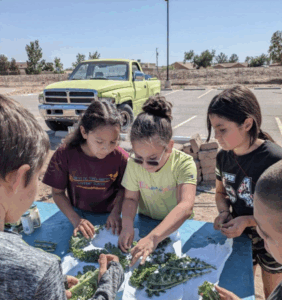
The school brings in local knowledge keepers to share their expertise with students. For example, one student’s family plays mariachi and comes to sing at the school and teach about that musical tradition to kindergarten students. Last year, a community member built a tipi on the school campus; students were able to go inside and experience what life inside a tipi is like. The school has a garden on campus which is used regularly for hands-on lessons; students plant seeds, harvest crops, and learn to cook meals with the produce in both an outdoor and indoor setting. On the day of my visit, fifth graders were preparing kale wraps for lunch using garden produce; the week before, they had made kale chips, baked over the fire of an outdoor horno.
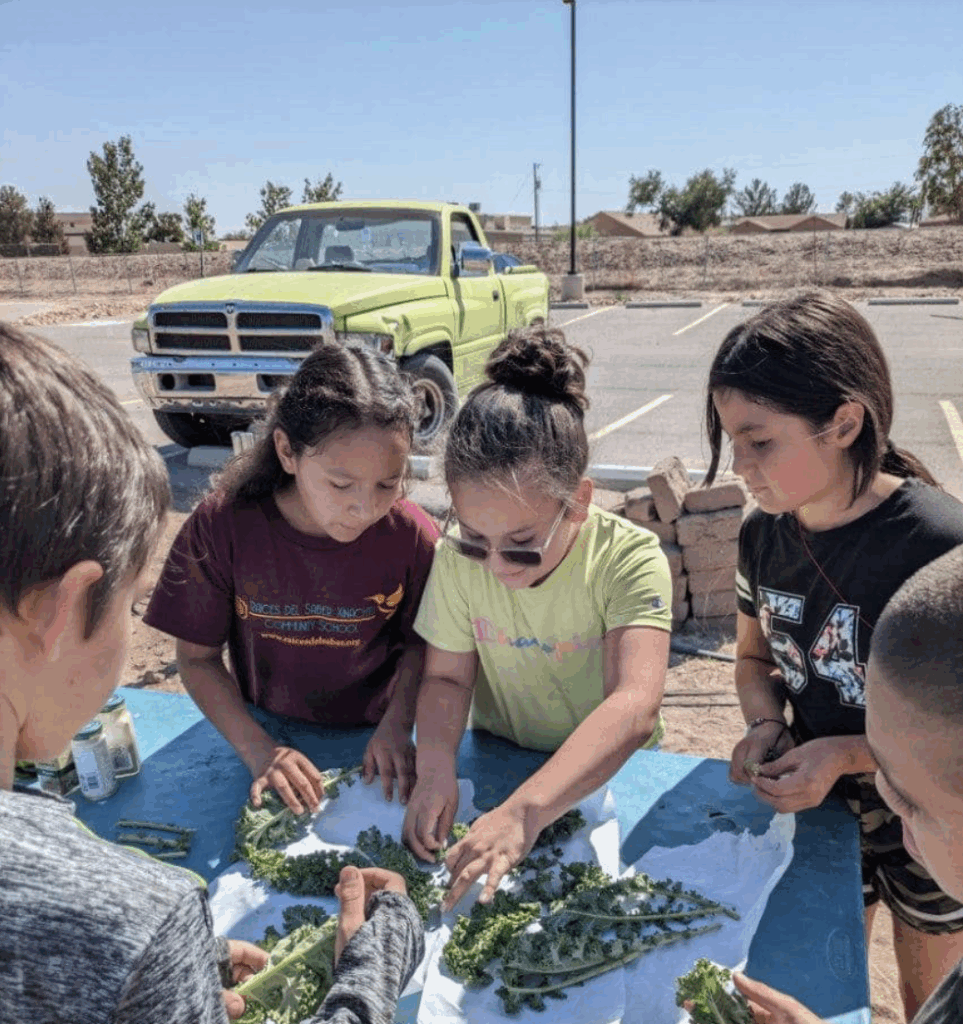
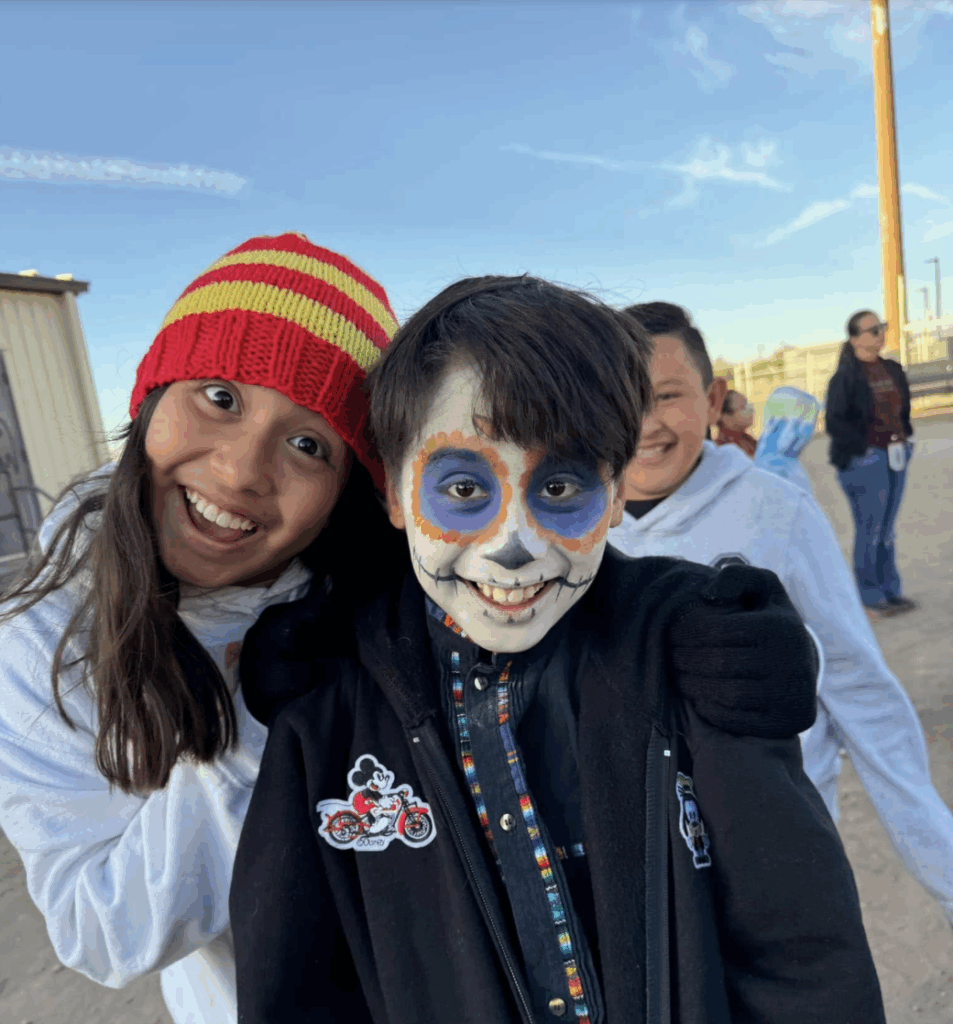
The school also organizes community events frequently throughout the year, often to celebrate important holidays and events or major milestones in learning. Third grade teacher Alessa Ibañez described the winter festival the school hosted this year as a vibrant celebration of learning: “It was in the evening; we put out luminarias. Students got to showcase their work, projects they were doing in school. The students sang a song in Nahuatl. Students in each grade got to show something they were doing to all the families.” One parent I interviewed mentioned how much she likes attending the school’s events because she always learns something: “At Raíces, each event we have is in Spanish, English, and Nahuatl. So that way we’re all always learning something new at every event. I always learn a lot, even as a parent.”
The intentional integration of high-level content and skills with real-world learning opportunities, connected to students’ lived experiences, has many benefits. Fourth grade teacher Roberto Moctezuma explained, “I feel that it’s very important for the students, especially nowadays. As a society, we’ve gone away from a natural way of learning… By doing this [Xinachtli pedagogical approach], it’s something that students will take with them for the rest of their lives. They’re able to see something in a different perspective. The society we are currently living in is very materialistic, not really taking care of Mother Earth. [But] if we don’t, we won’t have her around, and we won’t be around! So for the kids to really understand and grasp that knowledge and understanding is very important to me. That’s the reason why I’m here.”
Culture of belonging, safety, and care
“The school climate is welcoming and fosters trust among students, families, partners, and staff. Each person in the school community is valued for their rich diversity of experiences and is encouraged to share their views, knowledge, and culture. The school becomes a place grounded in healthy relationships, in which members feel safe and comfortable navigating conflicts and taking risks. Students feel connected to and are active participants in the school community.” (Community Schools Coalition)
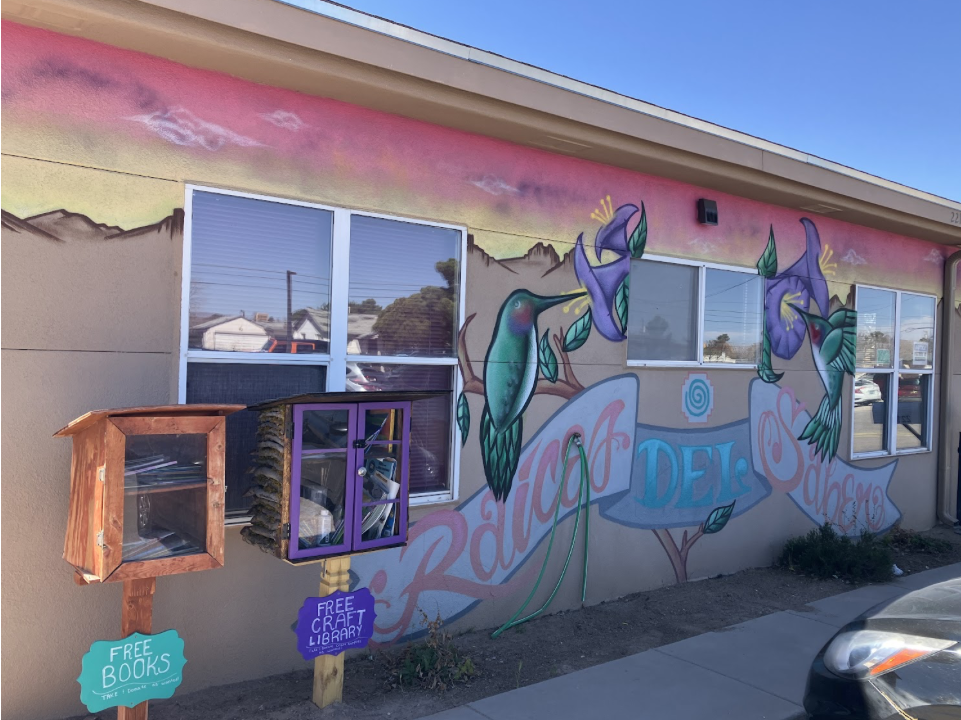
Creating a culture of belonging is a central part of Raíces del Saber. The welcoming environment begins the moment you arrive on campus. Colorful murals telling creation stories and emphasizing the interconnectedness of the natural world decorate the walls of the school; many of these murals were painted by students. At the front entrance, little free libraries offer books and craft supplies to passersby. Posters, photographs, flags, and art adorn the walls of the buildings, emphasizing the support of a community both local and far-flung. At the Aztec New Year celebration, visitors and guests were greeted and introduced, invited to speak in whatever language they felt most comfortable.
This intentional creation of a welcoming culture is also present in pedagogical practices. As described in the first post, the school has a series of schoolwide practices meant to help create a shared culture and set of norms. This includes morning saludos (a ritual greeting of the cardinal directions, the earth, and the sky), daily mindfulness practices, weekly cuentos (stories), and daily tlahtocan (community circles). Students also regularly recite a short statement aloud, repeating it confidently in Spanish, English, and Nahuatl. The statement is intended to remind them of who they are. Teacher Alessa Ibañez described it, making the same hand motions I had seen students making earlier as they recited it aloud: “Butterfly, hummingbird, eagle; wisdom, strength, beauty. This means that every student carries wisdom, every student carries beauty, and every student carries strength, whether it’s physical or whether it’s emotional, in heart.” Together, this constellation of practices is intended to be connective-connecting students to their body, their emotions, the land, and the community. “When we practice mindfulness, students learn to be aware. They learn to really feel their teyolia and see how they’re doing. Am I doing good? Am I sad? Why?… So those are things that we are doing, little by little, so that students are critically thinking about those things,” explained Ibañez.
Even the school’s approach to bilingualism and biculturalism is asset-based and emphasizes helping students feel safe to take risks. Although the school uses a 90/10 model, meaning that instruction happens primarily in Spanish in the early grades, students are not reprimanded for speaking whatever language they are most comfortable in. Teachers gently encourage them to repeat their idea in their less-dominant language, and I witnessed students correcting each other’s grammar in both English and Spanish, kindly and without any shaming. This encourages risk-taking by reminding students that they are safe to learn by trying, and also ensures that the school remains an inclusive and welcoming place for all students, regardless of their personal heritage or linguistic background. One caregiver whose grandson attends the school explained her gratitude for this approach, and the ways in which she is also trying to model it: “My grandson understands Spanish very well but for some reason, he’s reluctant to speak in Spanish. And I don’t speak Spanish at all. I understand, but I don’t speak it. So I’ve asked the school to speak to me only in Spanish so that I can become more fluent and more comfortable in speaking it. And if I mispronounce something, that’s ok! [And I hope that] therefore he will be more comfortable in speaking it too.”
Integrated systems of support
“To promote healthy learning and development, a dedicated team composed primarily of school staff and community partners intentionally and systematically coordinates services, supports, and opportunities that foster individual and collective well-being, using an assets-based approach to nurture the strengths and address the needs of students and families.” (Community Schools Coalition)
For a small school (approximately 110 students grades K-5), Raíces has a relatively large staff. This is because of the extensive support services that the school provides. Every classroom has both a lead teacher and an assistant; after-school programs are led by additional staff. As Dr. Girón explained, “[We have] a tremendous focus on meeting the needs of the children. We do have a very high needs population in terms of poverty. As a Title I school, we provide breakfast, lunch, and dinner for the children. We provide an extensive after-school program that helps the families whose parents work and can’t get out at 2:30 or 3:00 to pick up children, and so we provide that service and provide dinner for those children.” The school also meets basic needs in other ways, like providing check-ups at school through a partnership with a local medical provider.
One caregiver whose student has special needs described the ways in which the school proactively worked with her to ensure her child received needed services. “They’ve been very helpful in all of the different aspects where he needs a little help,” she explained. “The school caters to what kids need. [At a different school], he might be lost in the shuffle and I think that he would probably be mislabeled a lot of things that he’s not. Raíces understands that.”
These holistic supports are not merely supplemental; they are essential to enabling learning. As Teacher Alessa Ibañez explained, “If we’re not meeting a child’s basic needs, then they’re not going to be able to learn. So that means if they’re not doing well emotionally, there’s no way that the student will be able to sit down and perform or do any math, reading, or writing. And so for us to start the day and ground ourselves in who we are, I think that sets the tone. And yes, we have students that come in [later] who are not aware. They can tell that it’s very different, but they get to learn from their peers. And once they start learning, and once you start meeting those needs, especially emotionally or mentally, or challenges–even behavior–then you start seeing that eventually the student will be ready to do math.”
— — — — —
The work of a community school like Raíces del Saber is fluid and responsive, difficult to neatly define. Myriad experiences build on each other to reinforce a message of support, care, commitment, and mutual belonging–that community of love that Dr. Girón continually references. Ibañez agreed: “We’re a community-based school, and so students learn that we’re not just here to come to school and learn. We’re here to build the community. We’re here to learn from each other, to hear each other. And I know that is something very hard, especially now with technology, but it’s beautiful to see the community in the way that students are speaking. If you were to go to a different school, there’s a difference in how students speak and how they see community within each other.”
Looking Ahead
This post is the second in a series exploring Raíces del Saber Xinachtli Community School. In the next post, we will take a closer look at how the school enacts personalized, competency-based educational practices while maintaining its commitment to Xinachtli pedagogy.