TLA Blended Learning Snapshot: Connecting Every Learner
An in-depth profile of Lindsay Unified School District’s efforts to provide students with home Internet access. Includes useful strategies and artifacts.
An in-depth profile of Lindsay Unified School District’s efforts to provide students with home Internet access. Includes useful strategies and artifacts.
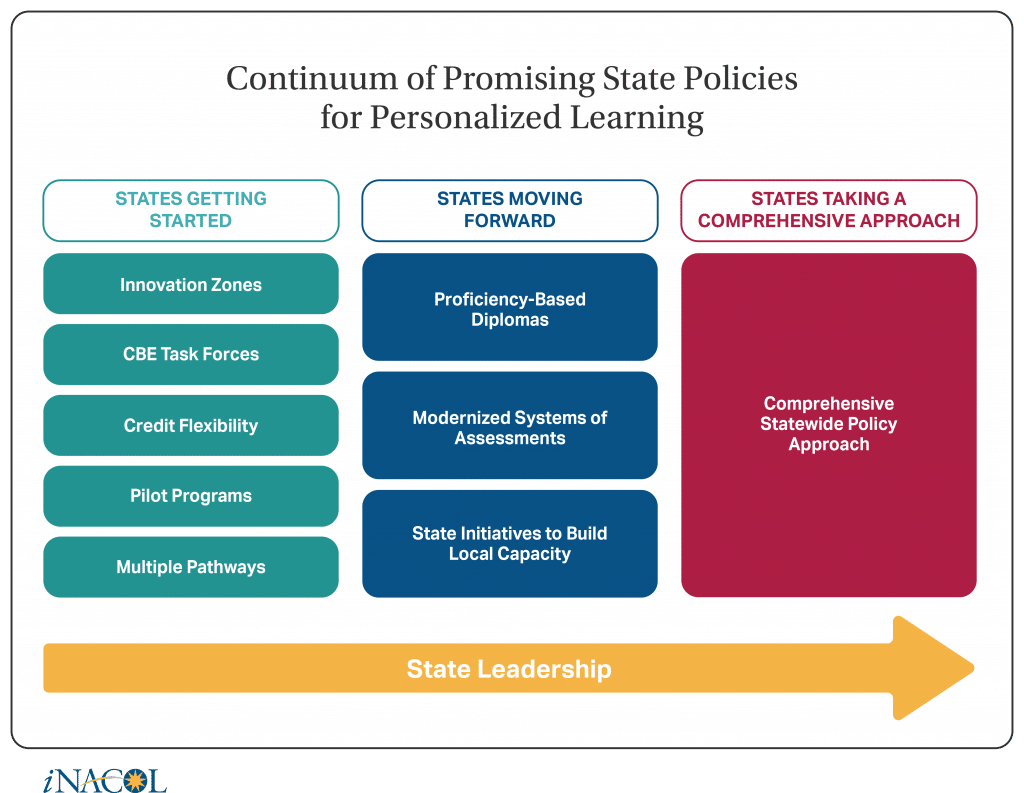
iNACOL published the report Promising State Policies for Personalized Learning to highlight specific state examples of promising policies to support and scale personalized, competency-based learning to close equity and achievement gaps. This executive summary outlines the policies in that report.
Personalized learning can:
Students will learn how to take control of their learning. Teachers will have high expectations for every student, know how they learn and adjust instruction to meet students’ learning needs.
By meeting students where they are and using advanced technologies to personalize learning at scale, these innovative models enable students to achieve dramatically improved outcomes. The goal is equity as well as excellence as the system must change to meet the needs of all learners. The system must learn how to address the needs of people they have never successfully served as well as how to operate at the leading edge of pedagogical and organizational innovation.
We encourage state policymakers to advance a set of the following promising policies in a way the fits within their state’s unique policy landscape and education system.
Summit Denali articulated a variety of routines for both students and teachers to support personalized learning time. This document lists these routines and also provides context for their implementation.
BetterLesson worked with 11 blended learning master teachers nationally to capture and share their individual strategies for using technology to use technology in strategic and innovative ways to personalize the learning of their students. Explore these strategies.
Effective communications is a cornerstone of successful blended learning implementation. Strong two-way communications builds engagement, trust, and credibility. District leaders are recognizing the need for communications assistance to build understanding and support for their blended learning efforts.
Teacher Brandy Quintero explains how advanced students can work at a higher level in a competency-based learning system.

Transcript: Brandy Quintero: So at the beginning of the year, you know, when you first get to start knowing the student, you look at their data, but then when that actually translates to the person in the classroom it can be a little bit different. You’ve got to look at motivation, their personal intrinsic motivation. So she started working in – she was turning everything in on time, she had like the revision process down, she knew how to revise her own work, she knew how to get help. So she already had like some of those processes that you try to teach ninth graders when they’re coming in to be accountable for themselves; she already had those down. And so then I started realizing that the quality of her work, the synthesis of ideas, she was already naturally doing that. And so I just had a conversation with her back in November and I said, “Hey, you’re doing Level Four work already. Ninth and tenth grade standards are very similar as far as the reading-based – the Common Core,” you know. They put them into a bandwidth, and so you cite evidence at ninth grade, you’re citing it at tenth grade. So if you’re doing it a Level Four you’re actually kind of doing it at a tenth grade level already, because you’re doing it above a ninth grade level. And there are a few standards that are different between ninth and tenth. […] So I just let her know we went to our website and I said, “Here’s all the stuff for tenth B,” because that’s primarily what was different. I said, “This whole module about the Holocaust and reading foundationally U.S. documents, we don’t do that in ninth grade, but you’ve got to do it in tenth grade. So I’ll walk you through the first steps,” and I give the capacity matrix. I said, “When you’re finished with the first step let me know, or you can just move on by yourself.” And so she’s just been going off of the website and the capacity matrix and kind of doing her checklist. And when she finishes the work she turns it in to me and I give her feedback, and then I say, “All right, go to the next assignment.” And, again, just because of the level of student she is, I haven’t had to do a whole lot of direct instructions because she already came in with those skills. So we’re not limiting her to being like lock step, “No, you’ve got to do ninth grade your ninth grade year, tenth grade your tenth grade year before you can do AP language. No, you’ve got the skills. According to the state of California you do have to do the two years of English. But, hey, you can do them in one because you’ve got the skills. So let’s get those done,” and then next year as a tenth grader she’ll be in AP language.
Sophia Thomas, teacher, discusses how the team uses cumulative quizzes to gauge retention of skills.

Transcript: Sophia Thomas: …quizzes. There is one that is at the end of the unit. It’s just a cumulative quiz that goes back from all the units picking things, just to see where retention is at. One of the things that we recognized was that sometimes kids can hold on to the information for (only) so long. Forcing them to do a cumulative quiz every time is just reminding them that they are accountable for this information.
Summit Learning Program is a free program that helps public schools bring personalized learning into their classrooms. Schools apply to join the program, working with Summit Public Schools. Selected partner schools explore personalized learning and adapt it to meet the specific needs of their individual school populations with ongoing support from the program, unlimited access to Summit’s Learning Platform, curricular resources, and engagement with other schools through a community of practice.
This video, created by the Highlander Institute, shares information on Pleasant View’s journey to blended and personalized learning.
