Craft Category: Artifacts

Beginners Guide to Blended Learning (Relay GSE course BL-101)

This course will teach you about blended and personalized learning as a whole, and show you how to stretch your thinking and try something new. You’ll learn the how and why of “blended” and how blended/personalized learning is changing the face of teaching and learning. You’ll leave this course with four blended “recipes” you can implement in your classroom immediately.

In this course, participants will:

  • Explain how blended learning can be used to support student achievement through differentiated instruction, personalizing curriculum, and/or engaging students in their own learning.
  • Describe key mindsets needed to be successful in a blended classroom.
  • Reflect on their practices in order to identify one instructional challenge that can be supported through blended learning.
  • Design and implement one blended lesson using one of the identified blended/personalized models.

Read More »

Reaching the Tipping Point: Insights on Advancing Competency Education in New England

This paper explores K-12 competency-based education policy and practice across six New England states: Connecticut, Maine, Massachusetts, New Hampshire, Rhode Island and Vermont.

This paper explores the core concepts of competency education, detailing the limitations of the traditional system, and how competency education is designed explicitly for equity and student success. Author Chris Sturgis then dives into why and how the New England region embraces competency education. She provides insights into policy strategies being used across states and analyzes the impact of competency education on quality, equity, scaling and sustainability. The Appendix offers a synopsis of each state strategy, complemented by short case studies of a few districts and schools.

Download excerpts of this report:

Download state profile excerpts:

Competency education is expanding across the country as a means to ensure all students are mastering the skills and knowledge to be successful in college, career and civic life. This paper explores the core concepts of competency education, provides insights in policy and practice across five New England states, and analyzes the impact of competency education on quality, equity, scaling and sustainability. This report draws lessons learned and insights from educators and policymakers in New England and is intended for district leadership and policymakers seeking to introduce competency-based education within their states.

This report is intended for district leadership and policymakers seeking to introduce competency-based education within their states.

Read More »

Meeting The Every Student Succeeds Act’s Promise: State Policy to Support Personalized Learning

Under the new federal K-12 education law, the Every Student Succeeds Act (ESSA), states have a historic opportunity to transform K-12 education toward personalized, student-centered learning. This law represents a marked shift in federal control to states, presenting state and local stakeholders with important opportunities and flexibilities to redefine student success and the goals of the United States education system.

This policy report provides recommendations for state policymakers to support local and statewide efforts to transform student learning in K-12 education through personalized, competency-based learning. Taken as a whole, the recommendations present a comprehensive state policy approach to transforming K-12 education. Such an approach will ensure every student can access powerful, personalized learning opportunities in order to develop the knowledge, skills and competencies they will need to be successful.

We encourage state leaders to develop and advance a coordinated set of these recommendations in a way that best meets the needs of students in their state.

Read More »

Promising State Policies to Advance Personalized Learning

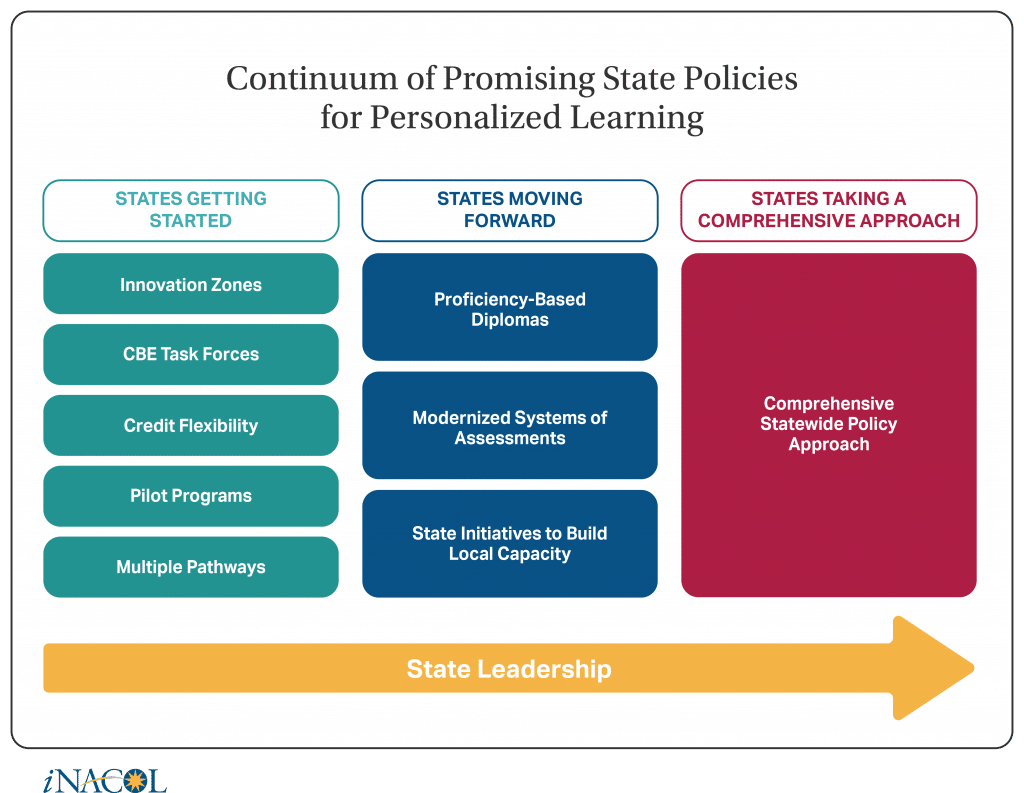
iNACOL published the report Promising State Policies for Personalized Learning to highlight specific state examples of promising policies to support and scale personalized, competency-based learning to close equity and achievement gaps. This executive summary outlines the policies in that report.

What Is the Promise of Personalized Learning?

Personalized learning can:

  • Dramatically increase equity in education;
  • Facilitate data-rich, powerful learning environments to create the conditions in which teachers and schools have the flexibility and capability to optimize learning for each student;
  • Support continuous improvement; and
  • Ensure all students, especially those from traditionally underserved populations, receive the necessary interventions and supports—exactly when they need them.

Students will learn how to take control of their learning. Teachers will have high expectations for every student, know how they learn and adjust instruction to meet students’ learning needs.

By meeting students where they are and using advanced technologies to personalize learning at scale, these innovative models enable students to achieve dramatically improved outcomes. The goal is equity as well as excellence as the system must change to meet the needs of all learners. The system must learn how to address the needs of people they have never successfully served as well as how to operate at the leading edge of pedagogical and organizational innovation.

We encourage state policymakers to advance a set of the following promising policies in a way the fits within their state’s unique policy landscape and education system.

iNACOL-PromisingPolicies-24Aug2016-2
Read More »

BetterLesson: Blended Learning Strategies

BetterLesson worked with 11 blended learning master teachers nationally to capture and share their individual strategies for using technology to use technology in strategic and innovative ways to personalize the learning of their students. Explore these strategies.

Read More »

TLA Recommendations and Resources for Communications

Effective communications is a cornerstone of successful blended learning implementation. Strong two-way communications builds engagement, trust, and credibility. District leaders are recognizing the need for communications assistance to build understanding and support for their blended learning efforts.

Read More »
Scroll to Top