Learn Next: Deeper Learning Resources
These resources were co-designed through a partnership between the Deeper Learning experts at the High Tech High Graduate School of Education and 2Revolutions.
These resources were co-designed through a partnership between the Deeper Learning experts at the High Tech High Graduate School of Education and 2Revolutions.
These resources were co-designed through a partnership between the Competency Based Learning experts at reDesign and 2Revolutions.
These resources were co-designed through a partnership between the Personalized Learning experts at the Institute for Personalized Learning and 2Revolutions.
This book, developed with input involving practitioners as part of the National Summit on K-12 Competency-Based Education, offers 16 Quality Design Principles to guide the development of competency-based learning with the goal of creating a system in which every student succeeds. While producing high-quality schools certainly requires attention to the structure, policy and operations, it also requires replacing the underlying beliefs and culture of the traditional system with an inclusive culture of learning. As states, districts and schools re-design education systems, the 16 Quality Design Principles provide a cohesive framework that offers a set of guideposts for schools and districts. While all principles are essential, districts and schools are using different entry points to begin transforming their systems and make different design choices. No matter the entry point, the depth of implementation or the model, the Quality Design Principles are composed to spark discussion that will accelerate the shift from the paradigm of the traditional system to one that seeks to have every student succeed.
This brief highlights recommendations for policymakers with guidance on strategies and action steps to drive the transformation of K-12 education systems to meet the needs of every student.
Policymakers, at every level, need to ensure the nation’s education systems are fit for purpose, equity-driven, capable of preparing all students – rather than only a portion – to graduate with the knowledge, abilities and dispositions necessary to achieve success, to contribute to their communities and to advance society.
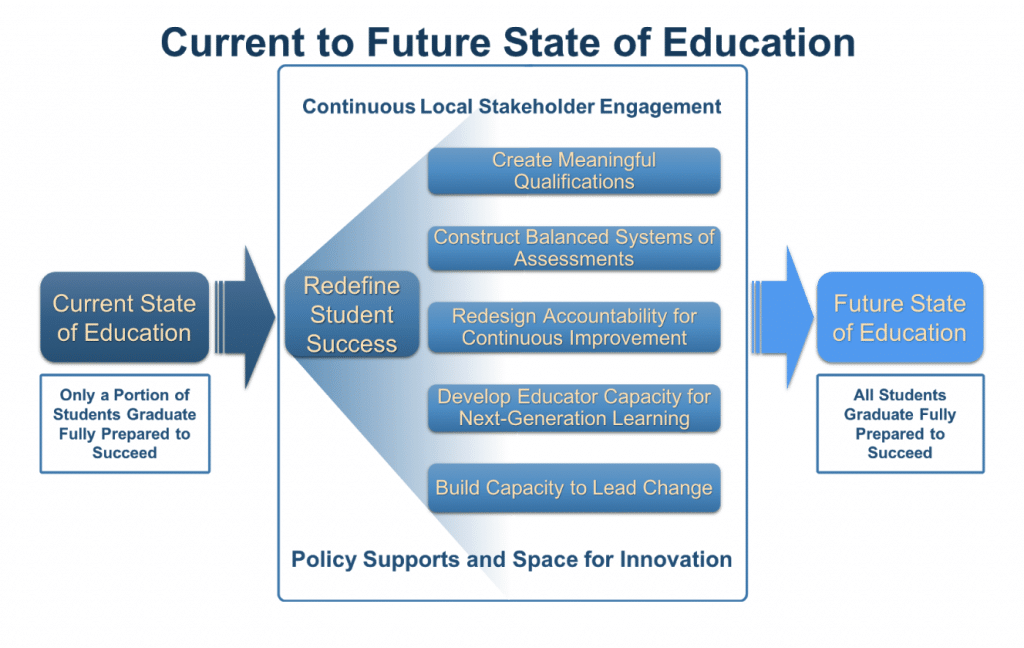
These recommendations move states forward from their current state of education to a future state with equity-driven systems of excellent educational opportunities by rethinking accountability, redesigning and aligning systems of assessments, building educator capacity and creating system coherence.
In January 2018, iNACOL published Current to Future State: Issues and Action Steps for State Policy to Support Personalized, Competency-Based Learning to provide state policymakers with a set of action steps to drive transformation of education systems for the long-term. These policy actions are designed to ensure that every student graduates with the knowledge, abilities and dispositions necessary to achieve success, to contribute to their communities and to advance society.
This executive summary includes the graphic below that draws attention to the following six issues to tackle from the report:
An infographic highlighting various ways to use the school schedule flexibly to create more opportunities for personalized learning.
There are three primary designs for providing access to community college for high school students: dual enrollment, concurrent enrollment, and early college.
Flex time periods offer students some degree of flexibility to follow their own interests and manage their own learning time, providing as much flexibility as the school structure and culture can support.
Unlocking Time is a national project that empowers K12 school leaders to adopt new time strategies that fuel student-centered learning. The project will gain new insights on how U.S. schools structure their time, provide a rich set of resources to help K12 school leaders align time and resources with their values, and provision administrators from eligible high-need schools with new master scheduling tools and services to implement new time-based strategies.