Based on the Universal Design for Learning (UDL) framework, the UDL Guidelines serve as a tool to help educators and other members of the education sector implement best practices when designing teaching and learning experiences, with the goal of providing multiple means of engagement, representation, action, and expression to develop learners.
In this episode of TLA’s “Beyond Brick and Mortar” podcast series, which features leaders of established virtual and hybrid learning programs from across the U.S. as they discuss what makes their programs a success – and what they had to learn along the way, we chat with Matt Bowman, founder and CEO at My Tech High. Learn about their innovative model focused on personalizing education to students’ individual goals and learning preferences, offering their students flexibility and a tailored approach to education – all at no cost to families.
This report urges leaders and policymakers to address five critical barriers to digital equity, moving beyond a sole focus on internet access and devices. These barriers include digital redlining, the digital use divide, privacy taxes, adult bias, and ethical concerns.
This post on the TLA Blog, authored by Jilliam Joe, explores how technology can be used deliberately and thoughtfully to complement education innovation, with a particular focus on topics of equity and social-emotional learning.
This Self-Assessment Tool is intended to foster productive dialogue within leadership teams in an iterative manner. Whether you are just beginning to think about digital equity or have been working on it for years, cycling through this tool will help to clarify vision and strategy, articulate needs, and identify areas for improvement. With your team assembled, as you work through the guide, self-assess to see where you might be on your digital equity journey. This tool has been created to support teams when using The Learning Accelerator’s Digital Equity Guide.
The digital equity audit process and tools are intended to foster productive dialogue within leadership teams in an iterative manner. Whether you are just beginning to think about digital equity or have been working on it for years, cycling through this workbook and the accompanying Self-Assessment Tool will help to clarify your vision and strategy, articulate needs, and identify areas for improvement. Each section includes questions to support team reflection as well as a template for exploring how you might make change(s) to improve. This tool has been created to support teams when using The Learning Accelerator’s Digital Equity Guide.
On this final episode of What Will We Take With Us?, a series featuring our conversations with education leaders across the United States on how they grappled with the COVID-19 pandemic in K-12 education, we speak with Scott Muri, Superintendent of Ector County Independent School District in Texas, about how leaders worked to make the most of the pandemic to accelerate the implementation of goals that benefitted the entire school community, ranging from expanding connectivity and internet access, to focusing on personalized professional development, to forging stronger, more meaningful connections between schools and student families.
This report offers guidance for K-12 districts and schools by synthesizing the latest research and knowledge on emerging practices for: 1) developing local habits of success frameworks, 2) addressing equity and cultural considerations in implementing habits of success and lifelong learning skills, and 3) promoting and assessing habits of success. The report also provides recommendations and next steps to support all students in building strong habits of success.
Habits of success are the skills, dispositions, and mindsets needed to continue as a lifelong learner and participate effectively in work and civic life. (They are also called 21st century skills, personal success skills, social-emotional skills, and noncognitive skills.) Schools, districts, and states have recently devoted an increasing level of attention to helping students develop habits of success.
Success in most professional and personal pursuits requires an additional set of skills and dispositions, in addition to academic knowledge, that can be learned in school and anytime/anywhere. These “habits of success” include self-direction, collaboration, communication, self-awareness, social awareness, and others. The extensive practice examples and research findings synthesized in this report will help practitioners implement frameworks to support students in developing essential skills for learning, work, and life.
When designing change in a district, it is essential that leaders hear directly from students, families, teachers, and classified staff (i.e., those most impacted by teaching and learning); this is often done via empathy interviews. As they reviewed their notes from their empathy interviews, the Cedar Rapids Community School District design team surfaced themes about opportunities to build relationships, to create more personalized and authentic learning experiences, and to reconsider effective feedback for students. The team’s discussion connected the themes from interviews to broader efforts across the district to engage students authentically, enable more personalized education, hold high expectations for all students, and facilitate standards-based learning that could help meet students’ needs.
Fewer than one in five American students follow a clear and uninterrupted path from high school through college to career. The promise of a public education is to prepare all learners to engage in, contribute to, and achieve purpose in the world, both as it is today and as it will be tomorrow. And yet, the American education system as we know it is insufficient to realize this commitment.
The idea of a compulsory high school education was developed in the early 20th century, when the Commission on the Reorganization of Secondary Education proclaimed the purpose of secondary education to be “health, citizenship and worthy home-membership and, only secondarily, command of fundamental processes.” Education leaders designed the American high school system to ensure that 20 percent of students would be prepared for college, 20 percent for skilled trades, and that 60 percent of young people would be prepared for “life adjustments” to become fully American.
This paradigm’s time is up. Today, complex and compounding forces compel something more than incremental change in public education. Skyrocketing racial and economic inequality perpetuates generational poverty, predominantly for Black, Latinx, Indigenous people, demanding that education do more to create social and economic mobility. The future of work means that a person entering the workforce from low-income households today will likely work for six or more decades, during which time they will change jobs every four and a half years and “upskill” every five.3 Social changes and advances in technology push more and more learning outside of formal institutions, creating opportunities for dynamic learning ecosystems to take the place of linear, time-bound institutions of schooling.
Call to Action
This book issues a call to action for states to enact a Learner Promise: a commitment that every learner will have access and support to pursue a certified pathway with system-wide opportunities that guarantee entry into a meaningful, chosen career that will build social and economic capital over the course of their lives. Operating under this promise, states would enact systems of governance, policy, and infrastructure to certify that learners who demonstrate competencies in K-12, postsecondary, workforce, and community settings along a supported pathway will have access to continuing education and a purposeful, living-wage
career. States would commit to taking the systemic action necessary to disrupt inequities in access, engagement, and attainment for Black, Latinx, Indigenous people, and people from low-income households. And, states would reimagine education not as a linear, time-bound sequence of learning that occurs within institutions of formal education, but as a learning ecosystem. This ecosystem would be an equitable, dynamic, and responsive system in which learners can customize their learning experiences as they navigate experiences across schools, workplaces, and communities.
What might this system look like?
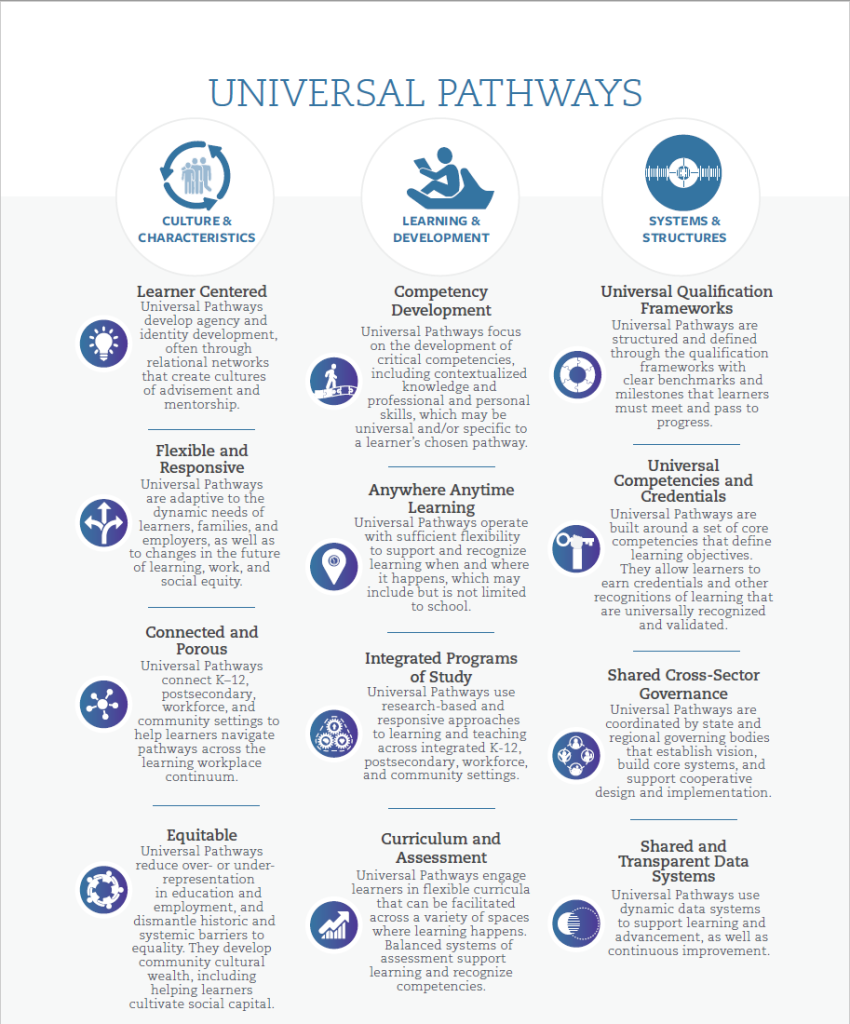
A system of universal pathways would articulate and certify multiple career pathways from K-12 through postsecondary education, career, and continuing education. Pathways would be transparent, universal, and recognized by schools and employers across the state. Each pathway would be defined by a progression of qualifying milestones and recognized credentials, which would certify that a learner has demonstrated a set of competencies across contexts and institutions on the basis of performance assessments. Coordination across K-12, postsecondary, workforce, and community would be enabled by a strong system of shared governance and dynamic, transparent data systems.
A system of universal pathways would focus on the development of critical competencies that support learners’ personal, professional, and academic development. It would recognize and support learning when and where it happens using balanced systems of assessment to evaluate and reward deep learning. It would prioritize cultural competency and align teaching with the learning sciences.