
When we launched the Rural AI Strategy Lab earlier this year, we expected interest. What we did not fully anticipate was the depth and consistency of what we would hear from rural educators across the country.
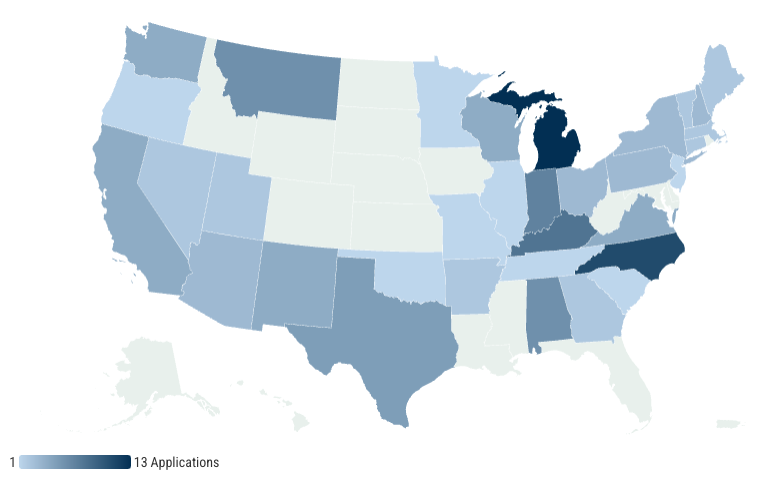
More than 100 school and district teams from 34 states applied to participate, and we had the opportunity to speak more deeply with over 30 of those teams through interviews.
Geographic Distribution of Rural AI Strategy Lab Applications
Looking across the applicant pool, a few patterns stood out.
What We Heard from Rural Educators—and Why It Matters for AI in Education
First, interest was geographically widespread, with strong representation across the Midwest, South, and Mountain West. Several states surfaced repeatedly, suggesting that this is not isolated to a single region, but a national signal emerging from diverse rural contexts.
Second, most applicants came from district or charter network teams rather than individual schools, pointing to rural systems approaching AI not as a single classroom tool, but as a system-level strategy.
Finally, the student populations represented reinforce the stakes. Many of these systems serve communities where a majority of students are economically disadvantaged, with meaningful proportions of students receiving special education services and growing populations of multilingual learners.
Taken together, this is not a story about early adopters experimenting on the margins. It is a story about systems serving diverse and often under-resourced communities actively seeking better ways to support students.
Across applications and conversations, teams expressed both excitement and caution. They see AI’s potential to expand opportunities and streamline workflows, but want implementation to reflect their local context, values, and constraints.
Several common challenges emerged, which will shape the focus of the Strategy Lab and reflect broader needs across rural education.
Expanding Access to Meaningful Career Pathways
Many teams pointed to challenges in connecting students, especially in upper grades, to meaningful and locally relevant career pathways.
In rural communities, Career and Technical Education (CTE) is often a critical lever for engagement and future readiness. Yet schools face constraints around staffing, scheduling, and access to diverse course offerings. Educators are exploring how AI might help expand access to career exploration, personalize pathways, and better connect students’ learning to real-world opportunities, while preserving the strong community ties that make these programs effective.
Supporting Diverse Learners
Another consistent theme was the growing complexity of supporting diverse learners as rural communities serve shifting student populations.
Teams described increases in multilingual learners alongside ongoing needs to support students with disabilities, requiring educators to meet a wider range of needs. In the words of one educator, “More and more we have so many needs in our classrooms…and for teachers it’s like ‘how am I going to meet everybody’s needs? I don’t have the time to prep the same lesson at four different levels.”
Many are exploring how AI can support language access, scaffold instruction, and adapt materials more efficiently, while maintaining accuracy and high expectations.
Making Differentiation and Personalization More Sustainable
Closely related was a broader challenge around curriculum and differentiation.
Teachers are being asked to personalize learning in increasingly nuanced ways, but often without the time, tools, or structures to do so sustainably. Rural educators highlighted the tension between ambitious instructional goals and the realities of small teams and wide-ranging student needs.
Across applications and interviews, there was strong interest in using AI to support lesson design, adapt materials, and provide just-in-time scaffolds while centering educator expertise and professional judgment.
Building AI Literacy Across the System
Finally, nearly every team surfaced a need for stronger AI literacy, not just for students, but for educators and leaders as well.
Teams shared a strong desire to build fluency and confidence with AI, but were often unsure where to start. They are grappling with questions like: What does responsible use look like? How do we move beyond surface-level use toward meaningful integration? How do we support staff who are at very different starting points?
Rather than rushing implementation, many applicants emphasized the importance of building shared understanding, curating clear entry points, and creating space for learning and experimentation.
Looking Ahead
To support this work, all Strategy Lab teams are participating in the AI Innovation Index to better understand the conditions needed for their AI-enabled solutions to succeed. Teams are also conducting research to better understand root causes of their identified challenges and will come together in mid-April to connect, collaborate, and begin generating solutions.
Later this month, we will share a nationwide field scan capturing the current state of AI implementation in rural education, highlighting where promising applications are emerging, what conditions are supporting progress, and what challenges still need to be addressed.
👉 Stay tuned — and if you haven’t already, subscribe to our email updates to be the first to see new releases and follow what we’re learning alongside rural educators.
For more, see: