When I walked into California Area High School in southwestern Pennsylvania, the first thing I noticed was a dog at the door. My instinct, I’ll admit, was to wonder what it was trained to detect.
But to my surprise, it was a therapy dog, one of twelve that work at the school, standing beside the principal as students arrived. Some knelt to pet him before heading inside. It was just part of how the day began. That moment stuck with me—not because of the dog itself, but because it immediately challenged my assumptions of what school could feel like.
FullScale recently visited California Area High School and Mountain View High School in Mesa, Arizona to learn from schools that embody elements of the Forge Futures vision for learning. Forge Futures (led by ReMake Learning and the School Superintendents Association) is a national initiative exploring how schools can better prepare young people for the future by rethinking where learning happens, who supports it, and what counts as meaningful learning. In an effort to show that vision in practice, FullScale looked for examples of:
- “School Un-Walled”: where learning extends beyond the traditional boundaries of the classroom, and
- Broadening Definition of Educator: where students are supported by a wider network of adults, relationships, and expertise
While each school serves very different communities, both are creating structures that connect students more deeply to their learning, interests, and the people around them. Below are some elements that most stood out to me.
When the Community Is the Curriculum
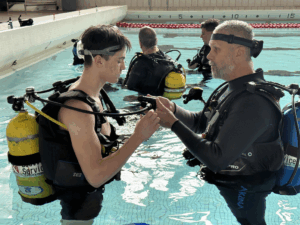
At California Area, students earn credit for volunteering with the local fire department, getting scuba certified, and traveling abroad. A veterinary technology instructor—a local industry professional—runs live labs where students help calculate medication dosages for animals. The school tracks all of it through the Village Transcript: a record that captures not just grades, but a broader range of what students know and can do, verified by teachers, mentors, and community members.
” (A Village Transcript) allows anyone within the community to contribute to the knowledge, skills, and dispositions that the child has. It’s showing the whole child, not just their grades.”-Dr. Laura Jacob, California Area School District Superintendent
Broadening Who Gets to Teach
A student walks the 60-acre Mountain View campus each morning carrying a generator-powered whistle he designed and built in the auto shop. He’s exploring how sound moves through space—it’s written into his learning plan. Nobody bats an eye. It’s just how that day starts.
Mountain View rebuilt its freshman year around small educator teams—teachers, coaches, counselors—who share the same cohort of students. By sophomore year, kids move into College and Career Academies where a neighbor with an Intel PhD teaches chemistry alongside credentialed staff. Parents run sessions. When a Holocaust survivor came to speak, her words resonated so deeply they were painted on the school wall. The community isn’t a supplement to the curriculum. It is the curriculum. Here, Mountain View has expanded who counts as an educator.
What’s Possible
For a long time, the rule has been that learning happens in front of a teacher between 8 am and 3 pm, inside a building, and it all gets written down as a grade. A student who spent three years volunteering at a fire station—learning to stay calm under pressure, follow a chain of command, show up when it’s hard—none of that made it onto the transcript. The school coach and office staff that checked in on him frequently were not considered integral members of his educational experience.
These two schools decided to ask a different question. Not “did this happen inside our building and classrooms?” but instead “did this young person grow?” That shift sounds simple–it isn’t. It means redesigning what a transcript looks like, who is responsible for teaching and supporting learning, and what the school’s relationship to its surrounding community actually is.
California Area’s graduation rate went from under 79% to 100% in five years. A Mountain View student reflected on the importance of relationships with caring adults: “I still go see him years later. He’s not just my teacher, he’s my friend.”
That’s what we came to document. These changes don’t originate from a budget line, but instead from a decision to stop treating the community as a backdrop and start treating it as the point. To ask who’s already out there, what they know, and what it would mean to ask them in.We invite you to read the full case studies for both California Area and Mountain View to see what that looks like up close.