This is the first post in a series of three posts about Raíces del Saber Xinachtli Community School in Las Cruces, New Mexico. In this post we introduce the school. In post 2, we describe the ways they embody the principles of community schools. In post 3, we focus on their student-centered, competency-based learning approach. Check out the whole series!
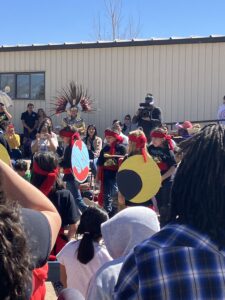
On a bright, sunny day in early March, the elementary students of Raíces del Saber Xinachtli Community School are seated in a circle outside, quietly attentive. In the center of the circle, two students–one wearing a cardboard costume of the moon, the other of the earth–slowly and carefully circle a third student, who is dressed as the sun. Solemnly, they walk one and a quarter laps around the sun, signifying the passage of another year. At the end of each rotation, they carefully pick up a short bamboo pole, slowly accumulating them in their tiny arms. Each time they bend down to pick up a new pole, the encircling crowd of students erupts in a cacophony of music, beating drums and scratching güiros, blowing whistles and conch shells. It’s jubilant and noisy, just as you would expect from a crowd of kindergarteners through fifth graders. Yet when the next rotation begins, they fall silent, respectfully watching the earth and moon circle the sun, awaiting their turn to celebrate again. After 13 rotations, they erupt in a final cheer, celebrating the arrival of the new year: Ce Tochtli / Uno Conejo / One Rabbit.
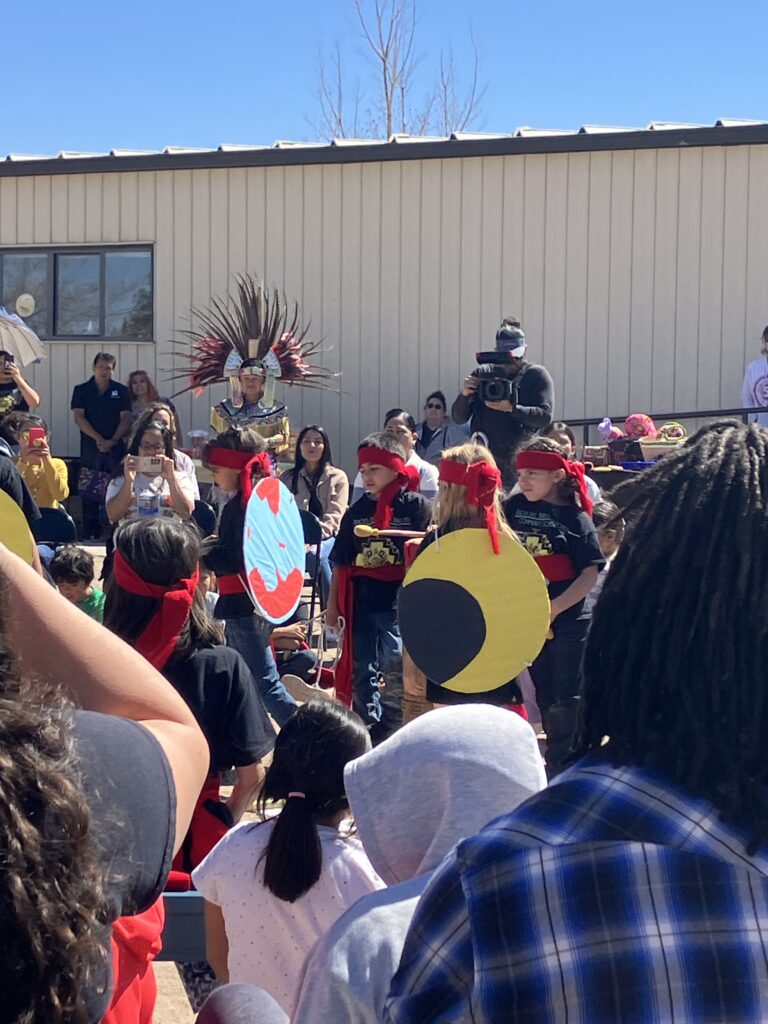
At this event, Raíces del Saber Xinachtli Community School is celebrating the Aztec New Year. As school co-founder Carlos Aceves explains to the encircling crowd of parents, teachers, and community members, the ceremony is more than just a celebration–though it certainly is that. It is also an experience in practical applied geometry, an opportunity for the children to embody some of the mathematical principles they study in the classroom. In celebrations like this, students deepen their understanding of culture, history, geography, astronomy, and earth science. “What we are presenting is a natural way of life and a natural way of learning,” explains Director of Operations and Community Engagement Lucía Veronica Carmona, a co-founder of the school.
Through this intentional design, Raíces del Saber embodies many of the principles of both community schools and personalized, competency-based learning, implemented through a culturally responsive and deeply place-based pedagogical approach. In this post, we introduce the school’s unique curriculum, pedagogy, and instructional philosophy. In subsequent posts, we will unpack the ways in which this school enacts practices aligned with both community school and competency-based learning models.
Curriculum and Pedagogical Approach
Raices is based on a Mesoamerican indigenous pedagogy called Xinachtli. Xinachtli is the Nahuatl word for the moment of germination, when a seed begins to sprout and is no longer a seed, but not yet a plant. That image of possibility captures the ethos of an elementary school like Raíces, explains Carmona: “A child is in that moment, sprouting. We have to nurture that.”
The Xinachtli pedagogical philosophy is based on natural ways of learning, with a focus on identity formation, critical thinking, and dual language immersion. The school philosophy is undergirded by a constructivist approach, as Dr. Hector Girón, Head Administrator, explains: “The idea is that students are active participants in their own learning and the process of understanding things.” The school’s guiding documents elaborate on this idea further: “[Students] do not enter school as empty containers waiting to be filled, but bring a rich experience based on family, culture, and community. Our purpose is to create a learning community which gives students… an education that includes success in rigorous curriculum, personal confidence, sensitivity and compassion towards self and community, and an independence to meet and transcend challenges.”
This active co-creation also extends to Raíce’s approach to identity formation. The school writes, “We believe that knowledge and appreciation for one’s ethnic heritage is an important part of positive identity formation and a culturally responsive curriculum. It is important for a student to explore, analyze, and understand their personal identity, which includes ethnicity, local community, family, and personal beliefs, ideas and feelings.” Although the school is rooted in Mesoamerican traditions of their borderland setting, not all of the students who attend personally share this heritage. The school welcomes students of many backgrounds, inviting all of them to connect with the natural world, the bilingual and bicultural realities of their borderland context, and their individual histories and cultures.
Foundational to this social-emotional and identity work are a few core schoolwide practices: morning saludos (a ritual greeting of the cardinal directions, the earth, and the sky), daily mindfulness practices, weekly cuentos (stories), and daily terlatocan (community circles). Fourth grade teacher Roberto Moctezuma explains, “It starts with the circle, because in that circle, we learn that we’re all equal. No one has more power than someone else. And in that space, kids, as well as adults, learn to first listen, and then that when they speak, everyone else will listen. So that teaches a very basic structure that I’ve seen from the students from the very beginning, to center themselves and to know that no matter what’s going on, they’re welcome to speak.”
Third grade teacher Alessa Ibañez continues, “Every morning they sit in a circle…. Students start learning to talk about themselves, share their stories with one another. We also have a cuento of the week, and we dive deep. What’s the message, and how can we see that applied within our school, within our community?… I think that helps us support students that come from all backgrounds, focusing on who they are, that they all bring something within the school. And we, as teachers, get to know them and how to use that information so that we can also engage them with the learning as well.”
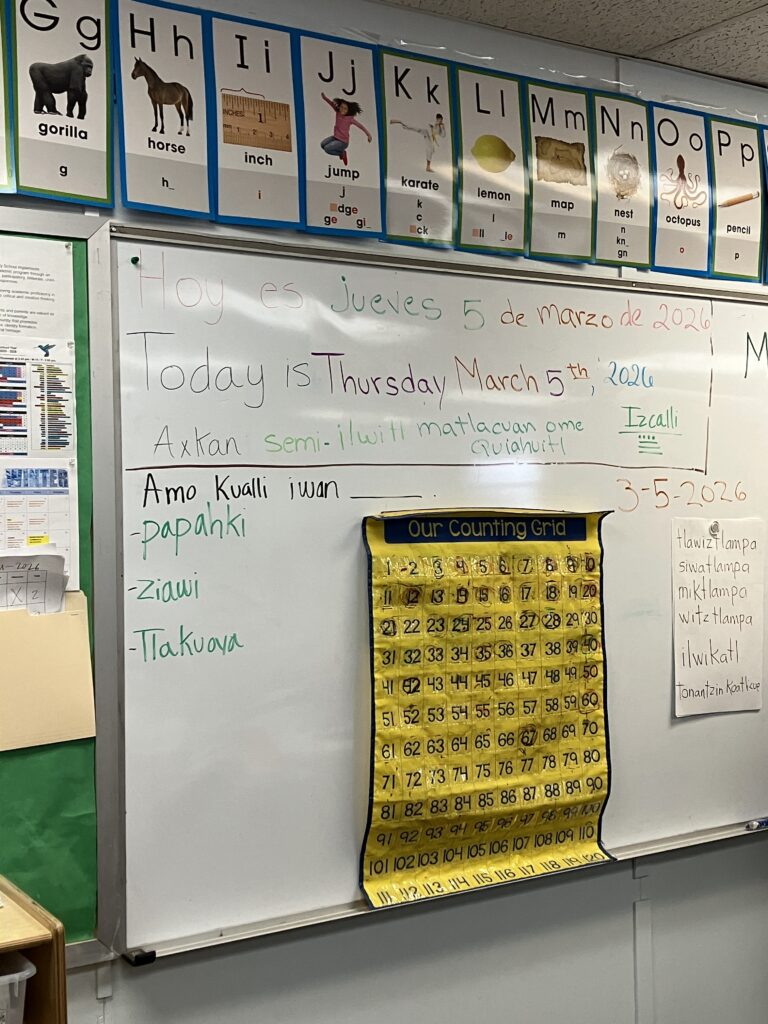
The learning curriculum at Raíces is broad and holistic. Students learn both the Gregorian calendar and the Aztec calendar, and both the base-10 math system required by New Mexico state standards and the base-20 mathematical system of the Aztecs. Raíces is also a dual language immersion school, where students are expected to develop biliteracy in both Spanish and English; the school also teaches all students Nahuatl. This expectation of multilingualism shows up all over the school. Students and staff switch seamlessly from one language to another, and signs and posters in all three languages adorn the buildings inside and out. In fact, many of the classrooms have three alphabets circling the top of the walls–one in Spanish, one in English, and one in Nahuatl. “It seems like it gives [students] more tools, not only in math, but in language,” explains Moctezuma. “By knowing three languages, they’re able to connect some of the words we bring up to them in content, whether it be language content, math content, science content–there’s always a connection in everything. Sometimes I think people feel like it’s easier, but really it’s not. It’s more rigorous because of everything else we still do, obliged by all the common core standards the state requires, plus more.”
Learning Rooted in Love
Raíces is committed to this deeply contextualized, culturally responsive pedagogy and curriculum, because they believe it works–not only in developing students intellectually and academically, but as humans. As Dr. Girón explains, “If I focus on the whole child and ensuring that the program we’re driving is supporting them [in reaching] proficiency, [academic success] will be taken care of.” With tears in his eyes, he continues: “I believe education is done out of love. We educate our children out of love and a desire to see them succeed. And when we work together, let’s do this out of love and kindness. Because when they feel that from us, they will respond.”
— — — — —
After the second graders have completed the changing of the year, a local Aztec dance group, Tlaneztica Danza Azteca, enters the circle. They dance for the assembled crowd, led by drumming children, and then invite the Raíces students to come and join them. Slowly they teach them the steps to one of their dances, and the children practice. Then the drumming speeds up and the circle becomes a sea of bouncing joy: feather-crowned adult dancers surrounded by tiny kindergartners in Lilo & Stitch t-shirts, all dancing together to the drums. Watching parents are grinning and taking pictures, shielding their eyes as the dancers kick up dust. When the dancing concludes, Dr. Hector Girón invites everyone to stay and socialize. An ice cream truck’s tinkling song starts to play, and vendors selling fresh fruit with lime juice and tajín, handmade baked goods, fresh juices, and handicrafts begin to offer their treats to the crowd. Parents and children eat ice cream and give hugs, a group of little boys starts playing soccer, and pop music begins blasting out of the speakers. Students tug their parents by the hand into their classroom to show them their latest projects hanging on the walls. The day feels like a celebration, a tangible expression of love for this community–both special and somehow, a day like any other.
Looking Ahead
This post is the first in a series about Raíces del Saber Xinachtli Community School. In the next post, we will take a closer look at how the school enacts the core principles of the community schools framework The third post will examine personalized, competency-based educational practices that the school enacts.