

To drive a black cab in London, you have to pass “The Knowledge.” It’s a test that takes three to five years to complete. Would-be cabbies memorize roughly 25,000 streets and every landmark on them, then sit for a series of oral exams known as “appearances.”
About 25 years ago, neuroscientists at University College London scanned the brains of London cab drivers and found that their posterior hippocampus, a region tied to spatial memory, was measurably larger than other people’s, and even larger the longer they had been driving. The process of memorising and driving every street had literally reshaped their brains. Two decades later, a team at McGill followed people who lean heavily on GPS to get around. Over three years, the more they relied on it, the steeper their spatial memory declined.
Same destination. Very different brains.
That’s the lesson we think AI holds for schools. AI can now get a lot of students to the destination: the essay drafted, the problem solved, the answer found. But teaching them to navigate, and how they use those skills, is up to us. And the time to talk about that is right now.
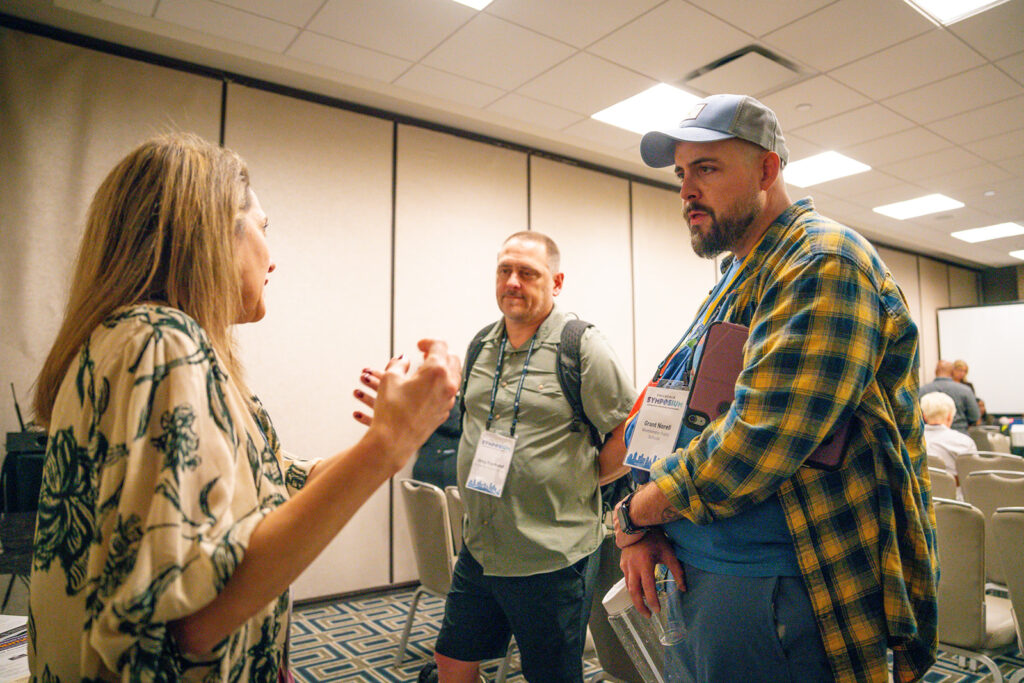
This urgent conversation made it to the mainstage at this year’s FullScale Symposium via a moderated conversation with three people who think about this for a living: Babak Mostaghimi, founding partner at LearnerStudio and former assistant superintendent in Gwinnett County, where he helped build one of the nation’s first AI-focused schools well before ChatGPT; Julia Freeland Fisher, who leads education research at the Christensen Institute and wrote Who You Know; and Sandra Moumoutjis, leader at Building 21 and co-designer of Beacon Learning, its technology platform which helps schools move toward personalized, competency-based practice.
We asked them and our audience to grapple with one core question: Are we using AI to make school faster, fairer, or more human? And can we have all three?
Listening to students first
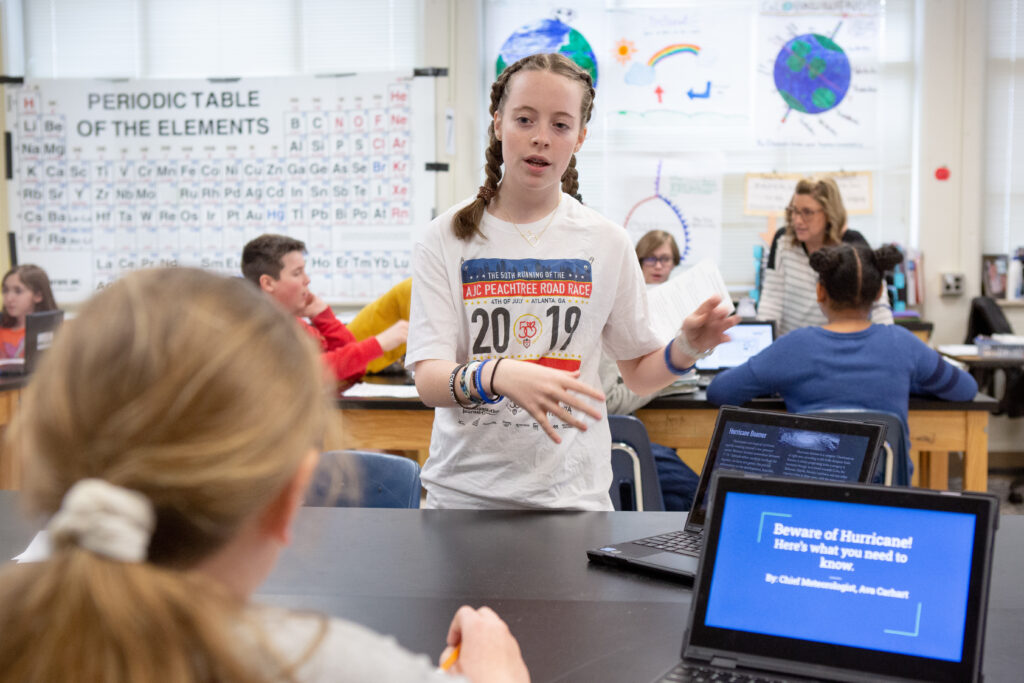
Before any adult said a word, we heard from some real middle schoolers on how they see AI. They were thoughtful, conflicted, and deeply worried about AI’s impact on the environment. (Polar bears came up. A lot. As Julia noted, polar bears are the new whales.) What Julia heard underneath was discernment: young people grappling with the fact that one thing can be good and bad at the same time.
We all heard a gap in understanding and trust. If all we teach kids is to fear the technology, we might just cede the ground to the worst versions of it. We need more spaces where students can share their stories without shame, without a cheating narrative, and without fear of being judged.
Faster, but toward what?
Babak told a story from his early days teaching in Mississippi. His school got a printer that could scan and auto-grade Scantron sheets. The next day, the administration required teachers to give only multiple-choice tests. AI could certainly get us to the same place, systematizing the worst parts of education. As Babak put it, “nobody likes the current system, so why are we making it faster?”
What direction might we move in, then? Sandra showed what the alternative looks like at Building 21 high schools where they’ve built Corbin, “your feedback sidekick,” on top of their competency progressions. Students can upload their work into Corbin anytime and get feedback that helps them name which competency they’re working on, what progression stage they’re aiming for, and what to do next. Ask Corbin to just rewrite it, and it politely declines. The result: students told Sandra their favorite part of school is getting to revise– something that’s nearly impossible to scale in human-only systems.
Fairness has to be designed in
We put the question that keeps us up at night to the panel: Are we heading toward a world where kids from affluent families get more humans and everyone else gets more bots? We’ve seen this pattern before, when well-resourced schools get new technology for collaboration and creation, while under-resourced schools, serving mostly low-income Black and Brown students, use it for test prep.
We have to focus on equitably distributing opportunities that build the deeper learning skills that employers are increasingly demanding, both virtually and IRL. And because an estimated half of jobs and internships come through personal connections in that same world, AI alone won’t help level the playing field.
(One practical note for every system using these tools: the federal disparate impact provision has been rolled back, which means vendors are no longer required to consider unintended disproportionate harm for specific groups of students. But districts are still responsible for student outcomes, regardless of intent. Disaggregate your data, and make sure AI isn’t quietly widening the gaps we’ve spent years trying to close.)
More human, even when it works
This is where the panel became most direct. There was disagreement on how much we want to anthropomorphize AI tools as members of our team. We have to treat real human relationships as outcomes if we want to prioritize them. And we have to be sure not to crowd out human relationship opportunities as students fill, as Julia puts it, their “social biomes” with AI agents and actors. If we value humanity, we also have to be willing to measure how human our systems should remain, from relationships to feelings of personal creativity and agency.
Can we have all three?
Babak described two camps in this discussion that both miss the mark: nostalgic humanists who long for a golden age of straight rows and blue books that never really existed, and techno-nihilists who think whatever technology can do, it should do. “All technology and no technology are both disastrous for kids,” he said.
The path forward is a middle way built around human flourishing–what we often call a “protopian” view. Educators have more power to shape it than they think.
It starts with what we count. Schools should be measuring what matters for life, career, and democracy – often called “durable skills” – not just reading and math. And student voice should be built into the process without calling inputs outcomes. (We’d add one caution: if we measure durable skills in the same soul-sucking way we often measure reading and math, it won’t go well.)
The panel closed with another cautionary story from aviation. Autopilot made flying dramatically safer, until the night Air France Flight 447’s autopilot disengaged over the Atlantic and the crew didn’t know how to fly the plane. The answer isn’t to fear the copilot. It’s to raise a generation of young people who understand how these tools work, when they don’t, and what to do then.
We know AI can get students to a destination. What matters is which destination, what the journey is like, and who they travel with.
Our deep thanks to Julia, Sandra, and Babak for their candor and humor, and to the MOXIE Public Schools students who took the time to share their thoughts. Here’s one thing to try this month: create a space where your students can tell you how they’re actually using AI, with no shame and no cheating narrative. Then tell us what you learn. We’d love to hear it here.