

When NASA was designing the Apollo program, one of the most consequential decisions had nothing to do with rockets. It was organizational: no single person– and certainly not a solo spacecraft pilot– could monitor all the systems of a spacecraft in flight. The solution was Mission Control as a room full of specialists, each flight controller responsible for one domain, each feeding information to a Flight Director who held the whole picture. Gene Kranz didn’t know every system intimately. He didn’t need to. The team structure meant that when Apollo 13’s oxygen tank exploded 200,000 miles from Earth, no one person had to solve it alone. Different specialists attacked different problems simultaneously. Ultimately, the astronauts came home.
The original moonshot succeeded not because NASA found one person capable of doing everything, but because they stopped looking for that one unicorn. The insight wasn’t better instruments for the Flight Director. It was a fundamental redesign of how they organized human expertise so that no single person carried what no single person can carry.
We think about this when we read the data on teachers.
New data from Gallup and the Walton Family Foundation, published this spring, documents what many of us already know from being in schools: more than half of teachers — 55% — report that the expectations for excellent teaching feel “only somewhat” or “not” realistic. Among teachers who say expectations are unrealistic, 77% experience frequent burnout. The researchers are careful about what’s driving this. It isn’t a lack of teacher skill or preparation. It’s that expectations for student achievement conflict “very often” or “always” with the time and resources available to meet them. Teachers are being asked to do too much, not because they’re incapable, but because no single person could do it.
The impact falls hardest on those who can least afford it. Fifty percent of teachers in the highest-need schools report that expectations conflict with student realities most or all of the time, compared with 36% in the wealthiest schools. When we talk about what sustaining teachers requires, we cannot separate that question from the question of which teachers, and whose students.
The conversation about how to address these challenges to teacher sustainability tend to land quickly on pay and appreciation, or on new AI tools and efficiencies. These things matter. Our team’s recent paper, From “Replacement” to Redesign, makes the case that the more fundamental challenge is structural. When teaching is organized primarily around task completion — planning lessons, entering data, grading papers, managing compliance — technology offers appealing shortcuts. But that frames the wrong problem. The question isn’t which tasks to offload. It’s whether we’ve designed the role so that the irreplaceable work (interpreting a child’s struggle, building the relationship that makes learning possible, holding sustained responsibility for a young person’s development) can actually be sustained over a career.
One more finding from the Gallup data supports this: teachers who receive excellent communication from school leadership are 51 percentage points more likely to be engaged at work and 38 points less likely to experience frequent burnout, compared with those whose leadership communicates poorly. The mechanism seems to be clarity. When teachers have realistic, clear expectations for their role, the job becomes sustainable in a way it simply isn’t when there is a fog of competing demands.
The gist of these findings is not new to this organization or field. In fact, there is a lot of energy around role redesign right now. Partners ranging from Next Education Workforce, to Public Impact, to Blue Engine have all offered valuable examples of how TA providers can help schools get on pathways to redesign. There are schools and systems building team-based educator models where different adults bring different expertise to students’ learning, no one person carries everything, and the job has been designed for human beings to actually do it. And funders across the country are raising questions about how AI can be an accelerant for change.
But, as we consider this present moment, we wonder what it will take to truly commit to build on this moment to make sustained change at scale.
Consider this: in 2014, The Learning Accelerator and iNACOL — which became the Aurora Institute — undertook one of their earliest collaborations: developing a competency framework for teaching in blended learning environments, built on the recognition that a new kind of instruction required a new vision of educator expertise. That same year, TLA partnered with TNTP on a working paper arguing that the traditional model of a single teacher holding all responsibility for every student, all day, needed to evolve into something more differentiated and collaborative. The role of the lone teacher, they wrote, was giving way to teams: researchers and developers, integrators, guides. “It is important to remember that no single teacher needs to possess the skills of each or all profiles on the continuum, but that building a team that reflects the full spectrum of attributes above is ideal.”
That was 2014. More than a decade before the current AI conversation made redesigning the teaching role feel urgent again. The ideas didn’t fail in the intervening years or get disproven. They got underfunded, understudied, underscaled, and underimplemented — the usual story for structural change in education.
The original moonshot worked because the people in that room understood that the goal required a fundamentally different way of organizing the humans doing the work. Our moonshot — ensuring every child in this country has access to educators who are well-supported, sustainably deployed, and genuinely able to do what only humans can do — requires the same reckoning. And, it requires much of the same commitment and sustained investment that put man amongst the stars.
So, it’s time to reckon with the question of what it would mean to truly raise up the people behind our schools. Not just to thank them or equip them with better tools, but to fundamentally ask: what job are we designing? Who is expected to hold what? How do we build educator teams where the whole adds up to something sustainable?
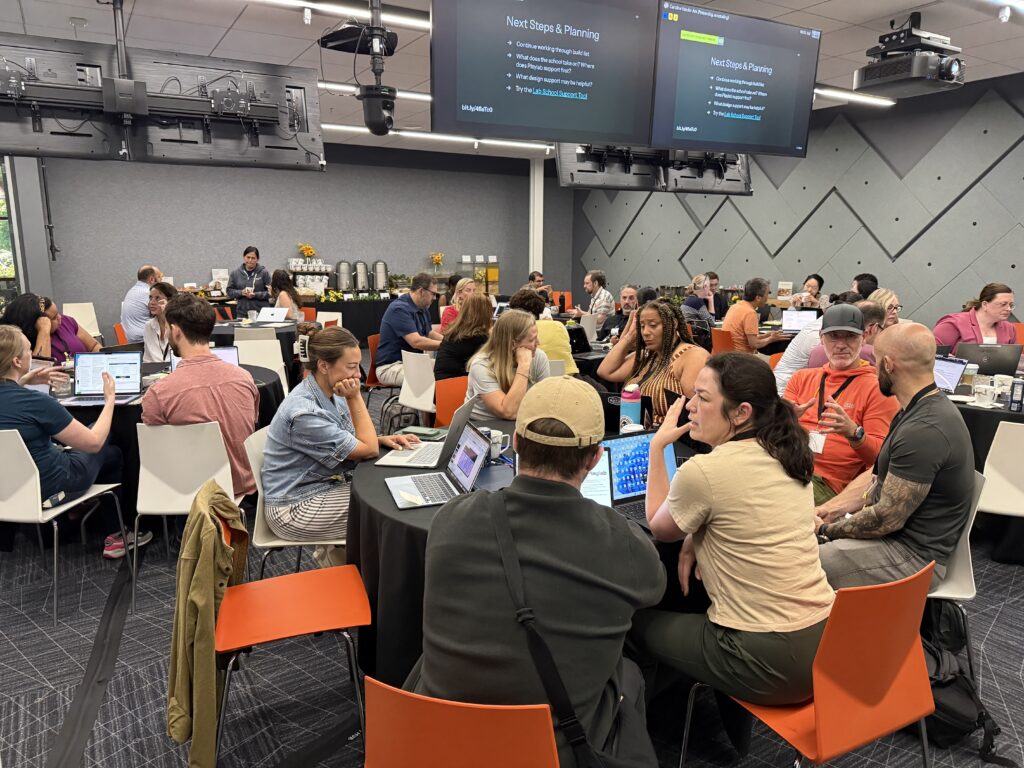
This fall, we’re bringing the FullScale community together in Indianapolis for our annual Symposium to ask these questions, together and with a focus on urgent change. One of the core strands running through the event is People: a series of sessions and workshops dedicated to the future of the teacher role and the conditions that allow educators to do their best work sustainably. Our People strand will feature leaders and practitioners who are already redesigning the teacher role — not as a theoretical exercise, but as an operational reality. Sessions will dig into what team-based teaching models actually require, what policies enable or block them, and how systems can build the clarity and support the research tells us teachers need.
We hope you’ll join us. And we’d love to hear what you’re seeing, what you’re trying, and what you think it’s going to take.