

At FullScale, our Evaluation and Measurement team works alongside education leaders to advance the field’s understanding of how systems, schools, and practitioners are moving toward more personalized, competency-based, whole-child learning approaches. We design and study measurement tools across diverse contexts, and adapt research methods and analytic frameworks to build powerful, contextualized evidence-based narratives about what’s working, for whom, and under what conditions.
The lessons that follow draw from our work with Washington’s Mastery-based Learning Collaborative (MBLC), a six-year demonstration project of mastery-based learning policy implementation involving 47 schools and 13 districts, and Wyoming’s Reimagining and Innovating the Delivery of Education (RIDE), a student-centered learning pilot involving cross-sector partnerships and 21 districts. We reflect on what we are learning about what it takes to initiate, scale, and sustain meaningful change.
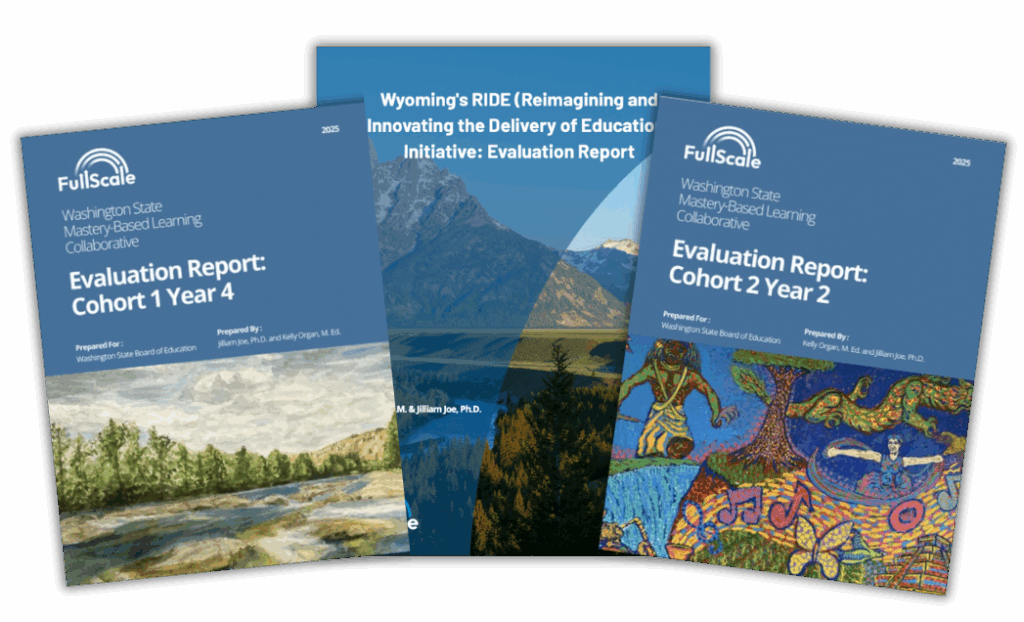
Read last year’s full reports here:
Mastery-Based Learning Collaborative Evaluation Report – Cohort 1, Year 4
Mastery-Based Learning Collaborative Evaluation Report – Cohort 2, Year 2
Wyoming’s RIDE (Reimagining and Innovating the Delivery of Education) Initiative: Evaluation Report
Connect The Dots: Why Coherence Remains Key To Early Momentum and Sustainable Change
In a world of competing priorities, and particularly amid the current turbulence in public education, ensuring sustainability requires state and district initiatives to be deeply connected to learning communities’ core goals, existing priorities, and strategy. Teachers are already balancing so many demands on their time and attention. If they can’t visualize the throughline between an initiative’s activities (whether those be professional learning, schedule changes, school redesign, grading reform, or something else) and the system’s vision for growth, they will be more reluctant to get on board with that initiative.
In fact, several teachers shared with us a belief that some student-centered learning initiatives are simply the latest “fad” in education that will be supplanted by another fad, so they plan to “wait it out.” This resistance to adoption is not necessarily anchored in an intractable attachment to the status quo; most teachers acknowledge that traditional approaches fall short for many learners. More often, it reflects the absence of a clear “big picture” blueprint for change: concrete examples, a strategy for piloting and studying new practices, and a plan for adapting them over time along with or in place of existing practices of good teaching.
To ensure that educators have the larger vision in mind, schools participating in Washington’s MBLC are required to develop a workplan that defines goals for how they want to transform their school and the concrete steps they will take to get there. Ideally this plan is developed collaboratively with the school team, and serves as a way to align the team’s vision and efforts towards a shared goal. Participating schools are then supported by an experienced coach, who can provide concrete examples, resources, learning materials, and strategies to make progress towards those aligned, shared goals. As one state leader shared, “school teams and even the entire schools really reflect on where they are, where they want to be, where the work needs to focus, and that [reflection process], along with their work plan, really guides the work going forward.” This, in their opinion, has led to a cohort of schools prepared to implement and sustain strong mastery-based learning practices.
The “Grammar” Of State Accountability Shapes The Conversation About Student “Success”
Washington and Wyoming have fairly different state accountability systems and priorities. Yet in both contexts, accountability structures rely on narrow measures of success, which create powerful incentives that shape school-level practice, often in ways that slow innovation.
The urgency to revisit accountability structures goes beyond concerns about “teaching to the test” or meeting a set of standards (though teachers do raise these concerns). Narrow accountability measures can limit schools’ freedom to develop reciprocal, community-centered accountability systems that better serve learners in the near- and long-term; constrain grading reforms by forcing qualitative assessments into rigid quantitative formats; and discourage experimentation due to fear of short-term dips in traditional measures of success
Our report highlighted a Wyoming district that went beyond the bounds of state accountability constraints to address a critical gap left by traditional measures of success. This district consistently performed well on state tests, graduation rates, and other accountability measures, which by most state indicators would be signs of a high-performing district. Yet district leaders began to question whether those measures were telling the full story about how prepared their students were for life after high school.
As one leader explained, some students graduate with strong academic records but struggle with skills like adaptability, autonomy, and navigating new environments once they reach college or the workforce. Recognizing this gap, district leaders took a closer look at how long-standing priorities had shaped their definitions of success. In response, they began expanding work-based learning opportunities, creating more personalized pathways for students with different postsecondary plans, and placing greater emphasis on essential human skills. This district’s experience points to the opportunity for states to rethink accountability in ways that better align with what educators and communities know students need to thrive.
Teachers’ Time Is A Real Constraint, But Not An Immovable One
One of the most significant school-level barriers to implementation is finding time for teachers to do the learning, collaboration, and re-design work needed to achieve deep transformation. Without significant, protected blocks of time for teachers to work together, progress often remains piecemeal or shallow.
Some Washington schools addressed this challenge by reorganizing their master schedules to create common planning time for teachers co-developing cross-curricular projects. Others designated dedicated professional development days specifically for transformation work. These strategies were frequently cited as critical, not only for building staff buy-in, but also for supporting long-term sustainability and preventing burnout. When teachers and staff see the tangible commitments to their development and initiative sustainability, they will support the work.
External Support Is Vital, But Personalization Really Matters
In both states, the initiative was supported by external technical assistance providers who provided professional learning and personalized coaching. (In Wyoming, the technical assistance providers also took on responsibility for convening state actors and designing much of the initiative; in Washington, the State Board of Education fills that convening and design role.)
All stakeholders saw personalized coaching as immensely valuable. By contrast, cohort-wide professional learning received more mixed reviews. Teachers often cited challenges related to the volume of information presented, expected time commitments, or a lack of alignment with their specific contexts and needs. These findings underscore a familiar lesson: external support is most effective when it is targeted, differentiated, and grounded in schools’ and educators’ lived realities.
Student Poverty Is Still A Huge Equity Issue–And Hardest To Measure
Not surprising, but worth stating: student socioeconomic status is a key factor in students’ experiences of and outcomes from school1—and this remains true in student-centered learning environments. This is not meant to dismiss other inequities. For example, we know that poverty is often correlated with other student characteristics, including race and English Learner status due to structural racism. But socioeconomic (dis)advantage remained a significant corollary of discrepancies in our findings this year.
This was true in our Wyoming study, where the students who ranked themselves as the “most privileged” also reported higher levels of experiences across all of the facets of student-centered learning and outcomes that we measured. It was also true in our Washington study, where Cohort 1 students who were considered “economically disadvantaged” had lower mean scores on almost every measure of mastery-based learning experiences than students who were considered “economically advantaged.” Despite its persistence, this gap remains under-studied and under-discussed, in part due to challenges in measuring student-level poverty in school-based research. We urge the field to continue investing in this area of inquiry if we are serious about serving students farthest from educational opportunity and justice.
Designing For The Most Vulnerable Students Helps All Students
Another unsurprising but important reminder from the 2025 evaluations: the importance of universal design for learning. In Washington, we found that the schools that were farthest along in their implementation journeys were also, on average, schools with the highest proportion of students with disabilities. When interviewing at some of these schools, we heard students talk about the ways in which accessibility features of the school had aided them—even if those accessibility features weren’t designed specifically for them. Design features like personalized learning plans, regular one-on-one meetings with advisors, and the ability to balance a workload that contains both traditional academic coursework and hands-on learning experiences were all cited as beneficial not just for students with learning differences and disabilities, but all students. There are many lessons to learn from the special education community that will support all schools in improving their practices around personalization and truly centering students’ assets and needs.
Student-Centered Learning Practices Contribute To Stronger Student Engagement
Our findings are clear that personalized, student-centered, competency-based education is good for students. In both states, students who experienced more student-centered practices also reported higher levels of engagement, connectedness to school, teacher-student relationships, and clarity about their learning.
This work is worth doing—and there are many learning communities that are improving learning, even if in incremental steps. Let’s continue learning from their example as we have in Washington and Wyoming, and move collectively toward an educational ecosystem that better supports and prepares every learner.
1 Lee, J., Zhang, Y., & Stankov, L. (2019). Predictive Validity of SES Measures for Student Achievement. Educational Assessment, 24(4), 305–326. https://doi.org/10.1080/10627197.2019.1645590