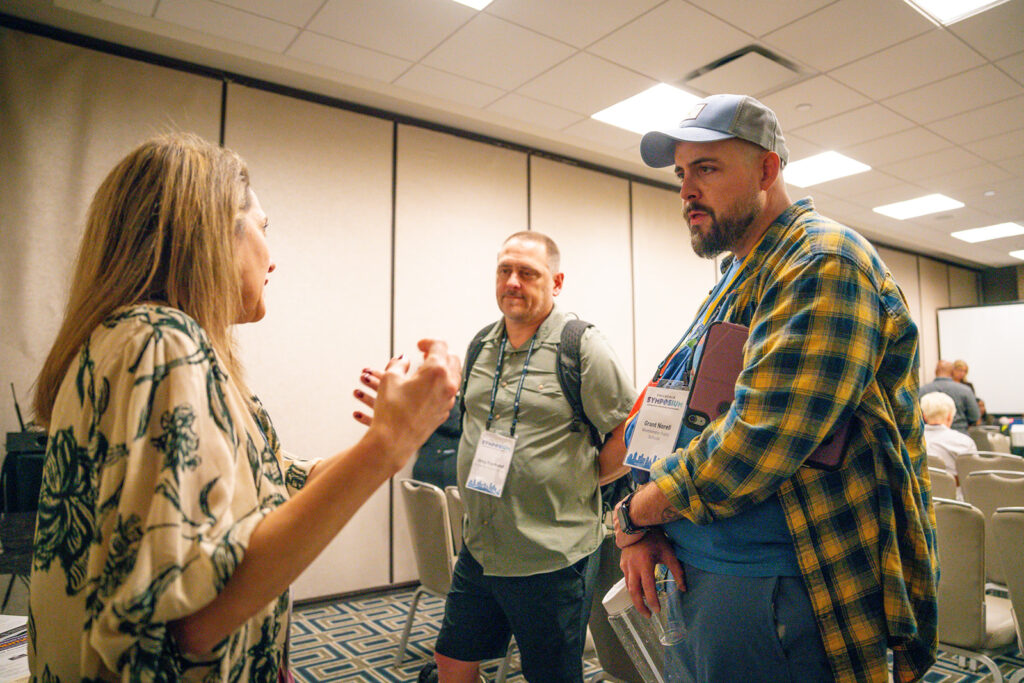

Members of the FullScale team recently had the opportunity to attend the 2026 American Educational Research Association (AERA) Annual Meeting. We presented on a wide range of topics, including statewide scaling of student-centered and competency-based learning, digital inquiry frameworks, increasing college access through social-emotional learning, and student experiences in culturally responsive educational environments. But we were also there to learn from other researchers and practitioners, build bridges, and hear about others’ work across the field.
Research, practice, and policy are often portrayed as separate silos, and certainly that sometimes is true. But many of the sessions we attended this year were focused on bridge-building across these sectors. FullScale aims to elevate these connections, amplifying sectorwide learning and building a path for collective action. In the spirit of that learning connection-making, we wanted to share a few observations and takeaways from this year’s conference.
Ashley Fellows, Managing Director, Practice & Implementation
This was my first time attending AERA, and as someone who doesn’t identify as a traditional researcher, I was genuinely struck by the sheer size, breadth, and depth of the conference. The range of topics and perspectives gave me real hope–there are so many meaningful corners of the field being thoughtfully studied, supported, and advanced. As a presenter, it was especially rewarding to share lessons from our work on the implementation and impact of SEL supports in online dual enrollment courses, and to engage with an audience that saw the value and relevance of this work. Experiences like this reinforce the role FullScale can play in bridging research and practice—ensuring insights don’t just live in papers, but translate into meaningful change in classrooms.
Kelly Organ, Partner, Evaluation & Measurement
I don’t know anything about neuroscience, so I was excited to attend an AERA session exploring connections between the science of learning and neuroscience. I’m always interested in seeing how we can learn from different disciplines to better understand our own work, and believe this bridging and translation is part of our work at FullScale.
One of the speakers in the session was Mary Helen Immordino-Yang from USC, who shared an overview of what she has learned over the years in her research at the intersection of these two fields. One paper she mentioned really stuck with me: her team followed a group of young people from adolescence into young adulthood to study their psychosocial wellbeing (e.g. satisfaction with themselves, their relationships, and their overall life circumstances). At the beginning of the study, they watched documentaries with the young people and facilitated conversations in which the students were invited to reflect on the world around them and how it might be changed. Unsurprisingly, some students did much more “agentic, transcendent reflection” (e.g. imagining that they could help create a different world) than other students. But interestingly, when they scanned the students’ brains, they found that the students who had more agentic, transcendent reflection in mid-adolescence also experienced more brain growth in the subsequent years, and this brain growth also predicted various positive psychosocial life outcomes into early adulthood.
This grabbed my attention because it points out neurological and biological evidence supporting something many of us have experienced in our own lives and seen in our own research: when you support young people in becoming agents of change, not merely passive recipients of the status quo, they flourish. Given the serious concerns about youth mental health in the United States, concerns about existential global threats like climate change, and current conversations in the field about how to make education more relevant to young people’s actual lives, this feels like a central truth to keep returning to. Student agency matters–and this work not only adds more weight to that claim, it also helps us understand why in a new way.
Jilliam Joe, Managing Director, Evaluation & Measurement
Somewhere between my senior year of college and the beginning of my doctoral program, I convinced myself I would be a professional student. I thought I’d be someone whose life revolved around questions and the quiet thrill of discovery in classroom settings. As life would have it, adult responsibilities and aspirations nudged me out of that dream, and turned that passion for learning into something more grounded.
As an educational researcher, I continue to chase that feeling of being unsettled by a new idea or pushed to reconsider what I thought I understood. That’s exactly what happened during my time at AERA. One session in particular—New and Emerging Histories of Education in the American West and Pacific Islands—has stayed with me. My connection to the topic (and the reason I chose the session) has been shaped by the evaluation research my team at FullScale is leading, which focuses on Washington State’s culturally responsive-sustaining, mastery-based learning initiative. This work calls us to be deeply and unapologetically attentive to whose knowledge and histories are centered in the work of systems transformation.
The session’s panelists, all of whom were historians, described the American West not just as a place but as a process shaped by Indigenous presence, immigrant histories, and the ongoing imprint of expansion and colonization. They challenged the familiar language of “pioneering,” naming it a Western expansion story that often obscures displacement and erasure. While all of that certainly resonated, what hit home was how directly this connects to schooling. These narratives don’t stay in history books. They’re passed down, often quietly, through curriculum, classroom practice, and standardized assessments, shaping what students see as truth or maybe for those in historically and presently marginalized groups, causing profound dissonance between school and lived experience.
Yet there was also hope. Panelists shared examples of educators reworking what and how they teach to translate fuller, more honest histories to their students. I left thinking differently about the work happening across Washington’s schools. I’m excited to strengthen our research through this refined lens, and to reinforce the work of educators and local communities who are making subtle, yet impactful choices about the content they teach to shape a more critically conscious generation of learners.
Beth Holland, Managing Director, Research & Policy
Across sessions, I kept noticing similar ideas, concepts, and trends, but presented in different ways. For example, I co-presented a poster as part of a broader session previewing the forthcoming 2027 International Handbook for Digital Literacy. Our contribution described Julie Coiro’s framework for Personal Digital Inquiry — a way of shifting the conversation from digital literacy as a thing to acquire, to digital literacy as an output of a broader, ongoing process. Later, I attended a roundtable on edtech and math, where two separate researchers presented overlapping papers on “math language” — specifically, how to develop it in young children. Both described different pathways to the same destination.
Since AERA, I’ve been thinking about that juxtaposition. Researchers talk about “math language” as something children develop over time, through practice and immersion, but there’s no counterpart with technology. The focus skips straight to “literacy,” implying a fixed competency to be achieved rather than a fluency to be cultivated. The framing matters.
This observation led me to a broader idea: so much of the coherence that could exist in our field seems to be obscured by language—not just across disciplines, but across the familiar silos of research, practice, and policy. People are often working toward similar ends, discovering similar things, and arriving at similar insights, but because the vocabularies don’t overlap, the connections go unmade.
It would be impossible to summarize everything we learned at this conference in a single blog post, but one theme really stands out: the need for bridge building. Researchers, practitioners, and policymakers—often working in different spaces and using different vocabulary—are circling many of the same core truths.
For us at FullScale, this reinforces the importance of making connections. If the field is already generating powerful insights, then part of the work is helping those insights travel—across silos, across contexts, and into practice in ways that are coherent and actionable. Bridge building isn’t just about translation; it’s about making sure good ideas don’t stay isolated.
We left AERA with new questions, new language, and a renewed commitment to this work. The challenge—and opportunity—ahead is to keep building those bridges so that this collective learning can fully shape the experiences of students and educators every day.