Competency-Based Education: State Policy Communications Toolkit
The Foundation for Excellence in Education developed this state policy communications toolkit around competency-based education.
The Foundation for Excellence in Education developed this state policy communications toolkit around competency-based education.
A collection of sample messages about blended learning, targeted to key audiences including parents, teachers and the community.
iNACOL’s 2017 paper is designed to inform schools, families and communities about the potential of personalized learning. This report describes why personalized learning matters and shows what personalized learning looks like in schools for teachers and for students.
A communications planning worksheet that you can use to list your communications goals, identify your target audiences and messengers, and form key messages.
A blog post by Anthony Kim, CEO of Education Elements, and Kira Keane, Partner at The Learning Accelerator, highlighting top communications planning tips for school leaders.
Education Elements and The Learning Accelerator partnered to create this communications guide which includes a streamlined planning process, real-world examples from eight school districts, and up-to-date resources and artifacts.

myON is a personalized literacy platform providing digital reading content and literacy tools for students.

CompassLearning Odyssey is a K-12 digital curriculum that includes diagnostics, assessments, and personalized learning paths.
MasteryConnect provides formative assessment and mastery-based learning solutions to help teachers and students identify and track mastery of learning standards.
This iNACOL Issue Brief provides an overview of competency-based education, and provides state policy recommendations and resources for policymakers who are ready to enable and support competency education.
Competency-based education is a next generation learning model that focuses on all students achieving mastery, preparing them for success in college, careers and civic life. State leaders can support policy for K-12 competency-based education to help all students succeed.
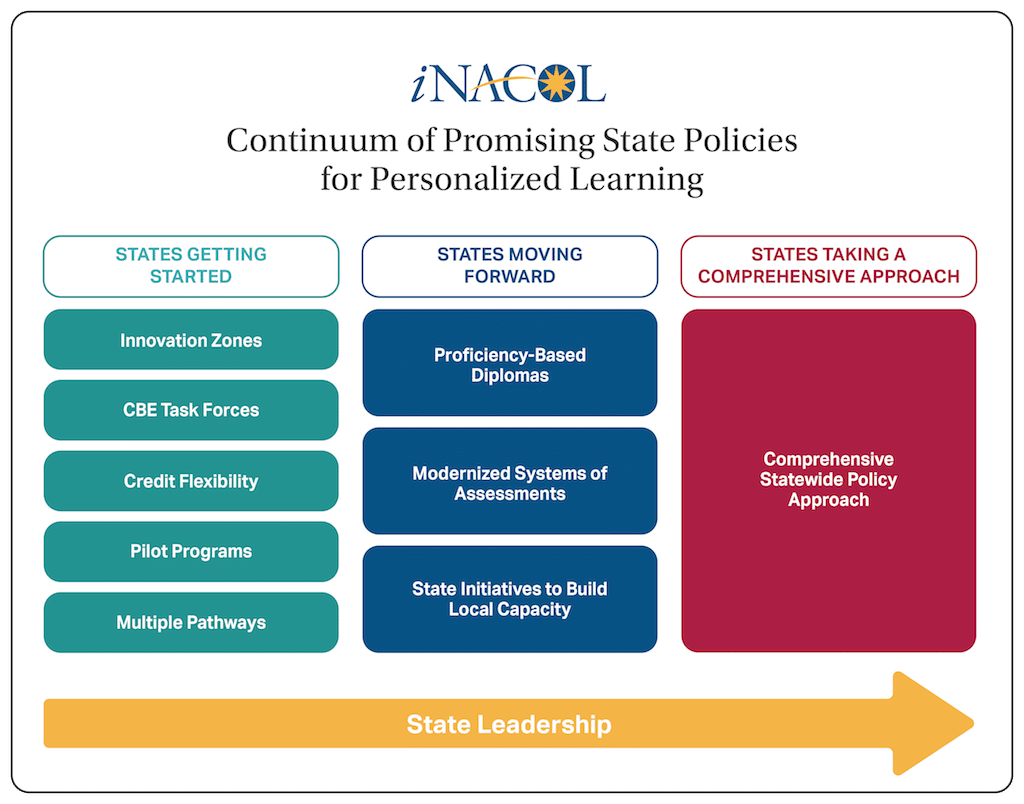
Fully-developed, student-centered systems require significant shifts in policy and practice. What can policymakers do to encourage a shift to K-12 competency education? No matter where a state is starting from, there are different entry points policymakers can take to enable and support competency-based systems. The graphic below summarizes the different entry points where policymakers can catalyze transformation of K-12 education in their state, with varying levels of state leadership: