Imagine Learning
Imagine Learning (formerly Think Through Math) is an adaptive math program providing instruction, practice and help from live teachers.
Imagine Learning (formerly Think Through Math) is an adaptive math program providing instruction, practice and help from live teachers.
CICS West Belden uses a student survey tool to assess interests and preferences. Results of this survey are put into a student’s Learner Profile to inform planning.
CICS West Belden has developed a master schedule to maximize allocation of student and staff time. Core blocks are lengthened to allow for rotations and additional independent practice, conferencing, and instruction time. Lunch and enrichment have been blocked together to allow for daily collaborative planning.

ThinkCERCA is an online platform designed to empower teachers to personalize literacy instruction.
CICS West Belden has defined a career lane system to articulate different educator roles and offer a path for professional growth.
Learn more about this research in our archived webinar on this report.
This paper illustrates the technical requirements and functionalities that learning management systems need to shift toward student-centered instructional models. This comprehensive framework will help districts and schools determine what systems to use and integrate as they being their journey toward student-centered learning, as well as how systems integration aligns with their organizational vision, educational goals and strategic plans.
Educators can use this report to optimize student learning and promote innovation in their own student-centered learning environments. The report will help school leaders understand the complex technologies needed to optimize personalized learning and how to use data and analytics to improve practices, and can assist technology leaders in re-engineering systems to support the key nuances of student-centered learning.
The realities of the 21st-century learner require that schools and educators fundamentally change their practice. “Educators must produce college- and career-ready graduates that reflect the future these students will face. And, they must facilitate learning through means that align with the defining attributes of this generation of learners.”
Today, we know more than ever about how students learn, acknowledging that the process isn’t the same for every student and doesn’t remain the same for each individual, depending upon maturation and the content being learned. We know that students want to progress at a pace that allows them to master new concepts and skills, to access a variety of resources, to receive timely feedback on their progress, to demonstrate their knowledge in multiple ways and to get direction, support and feedback from—as well as collaborate with—experts, teachers, tutors and other students.
The result is a growing demand for student-centered, transformative digital learning using competency education as an underpinning.
The passage of the Every Student Succeeds Act (ESSA) in December 2015, which reauthorized the Elementary and Secondary Education Act of 1965 (ESEA), ushered in a historic opportunity to rethink K-12 education across the country.3 The new law allows localities to create systems of assessments that meet students where they are in their learning by identifying successes or issues in real time, and to use multiple measures of student learning and growth for accountability. State policymakers have a chance to expand learning opportunities for students and create enabling policy environments to allow personalized learning to flourish.
This report is a valuable resource for state policymakers — whether they are seeking to create conditions in state policy to support personalized learning, moving forward with initiatives to develop personalized learning pilot programs, hosting task forces to explore policy issues and needs, or taking a comprehensive policy approach for supporting advanced personalized learning models. Personalized learning is where instruction is tailored to each student’s strengths, needs, and interests — including enabling student voice and choice in what, how, when, and where they learn — to provide flexibility and supports to ensure mastery at the highest levels.
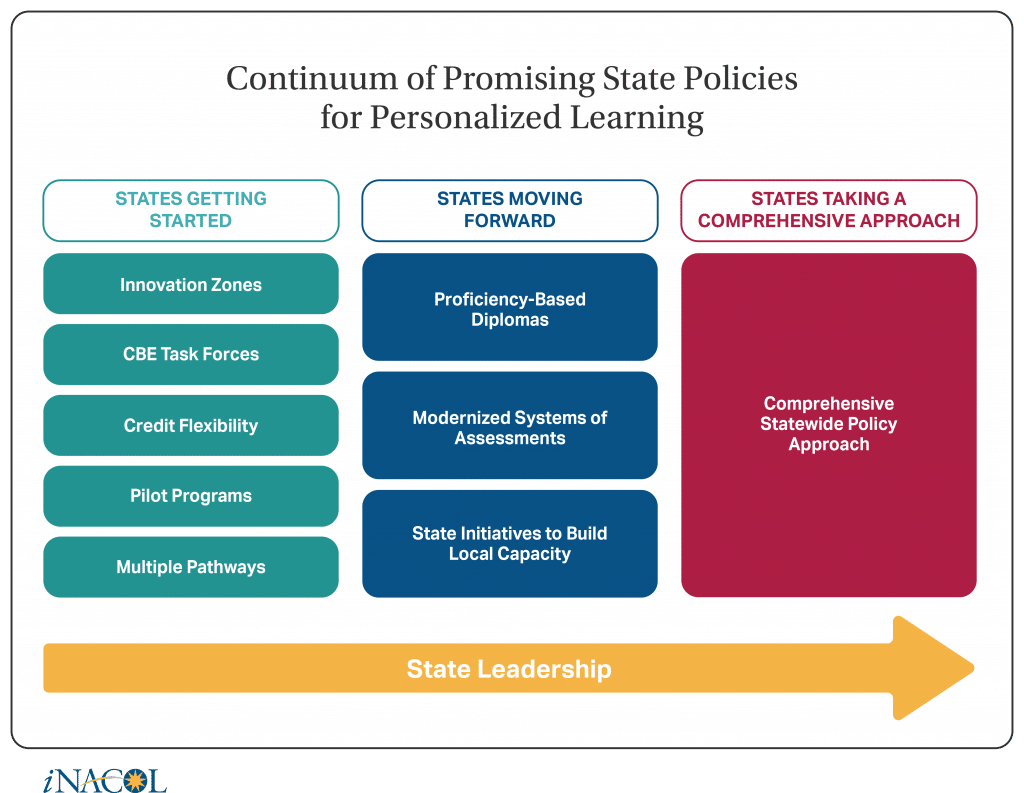
State policymakers can become partners with practitioners in identifying and removing system barriers to launching and supporting personalizing learning models to ensure each student’s success. In 2016, states have a historic opportunity to create flexibility to enable powerful, personalized learning experiences with the reauthorization of the Federal K-12 education law, the Every Student Succeeds Act (ESSA).
This policy issue brief describes what innovation zones are, why they are important and examples of legislative language from various states. Innovation zones or districts of innovation help state policy leaders identify outdated policies and regulations that may get in the way of educators designing innovative learning models. They create space for districts and schools to innovate, identify policy barriers and remove them through waivers. This brief is helpful for state policymakers to learn more about innovation zones or districts of innovation, why they are so important to catalyze the development of new learning models and examples of legislative language.
This paper explores how an Alaskan school district shifted from a traditional K-12 education system to a personalized, competency-based system, embedded in the culture of the community, which led to increased student achievement.
Chugach School District (CSD) first implemented competency education over twenty years ago, paving the way in developing a system founded on student advancement upon demonstrated mastery. This case study explores how CSD created the infrastructure to support a competency-based system, expanding learning beyond the classroom, embracing the culture of the community and developing educator growth.
With the community demanding that something be done about low student achievement, Chugach School District re-imagined what education could look like. They placed students and learning in the center surrounded by a structure that allows flexibility while ensuring students reach proficiency before advancing to the next performance level. As the first district to implement competency education in the United States, the pioneers at CSD paved the way in developing a personalized, competency-based system where failure is not an option.
The promising practices and lessons learned offered in this report provide K-12 education leaders and teachers with strategies to design and implement powerful, personalized learning models to maximize each student’s potential.
