The equityXdesign Collaborative has defined a spectrum of design power dynamics to help people starting on a design process to determine how they can best make their process inclusive and equitable. The spectrum shows three different approaches to inclusive design – user-centered, co-designed, or user-created design – each with a deeper type of engagement of those who will eventually benefit from the design process’ results (e.g., students, families, teachers, classified staff).
Mastery Charter Schools began a design process to improve teaching and learning with a team of academic executives. Important among the charter network’s mission and values is the weight they place on equity: “We disrupt systemic racism and the inequities that limit our students’ choices. We nurture a culture where all staff, students, and families are seen and valued.” As a team, they reflected on whether their composition would honor that commitment. When the group self-identified limitations to their perspectives and experiences, they took steps to include the voices of staff with vantage into the lives of students – especially those most marginalized. This approach ensured that the teachers and students closest to challenges in the district had a say in designing solutions. It also helped the team develop a design that could actually be used day-to-day, as teachers and students could provide an “on-the-ground” perspective to inform the work.
Attendance looks dramatically different in the COVID-19 era. Many states and districts have sent us requests to support the alignment of policy with a more innovative imagining of attendance that moves away from the old-fangled definition based on seat-time. We’ve responded with a new offering for the field, Determining Attendance and Alternatives to Seat-Time.
While COVID-19 offers numerous opportunities to advance systems change and free K-12 of its limiting factory-model structures, schools and districts are grappling with very real and present issues in ensuring students can access learning and progress along their learning journey. Our analysis shows that states can best remedy this issue by allowing the flexibility of districts and schools to develop an attendance policy using a combination of options. These options include, but are not limited to:
Time on task (can include engagement);
Participation;
Evidence of student work; and
Competency-based attainment with demonstrations of building skills, competencies, and knowledge.
The issue brief contains 10 examples for creating attendance policies for learning remotely, including competency-based attainment. In addition, we offer policies from four states using seat-time alternatives as one of many policies to advance toward personalized, competency-based education.
This report describes Vermont’s convenings to support schools, districts, and other education organizations seeking to create high-quality local comprehensive systems of assessments. It can serve as a resource for schools, districts, and states that are working toward improving their own assessment systems. Readers will learn about the rationale and essential components, formative and summative performance assessments, and student-designed performance assessments.
Local comprehensive assessment systems (LCAS) are essential for ensuring equitable learning opportunities for all students. They have the potential to ensure that each and every learner meets high expectations that are set across all content areas. The Vermont Agency of Education held convenings with educational leaders to refine tools and investigate resources that can improve local systems of assessments that support personalized, proficiency-based learning.
Fewer than one in five American students follow a clear and uninterrupted path from high school through college to career. The promise of a public education is to prepare all learners to engage in, contribute to, and achieve purpose in the world, both as it is today and as it will be tomorrow. And yet, the American education system as we know it is insufficient to realize this commitment.
The idea of a compulsory high school education was developed in the early 20th century, when the Commission on the Reorganization of Secondary Education proclaimed the purpose of secondary education to be “health, citizenship and worthy home-membership and, only secondarily, command of fundamental processes.” Education leaders designed the American high school system to ensure that 20 percent of students would be prepared for college, 20 percent for skilled trades, and that 60 percent of young people would be prepared for “life adjustments” to become fully American.
This paradigm’s time is up. Today, complex and compounding forces compel something more than incremental change in public education. Skyrocketing racial and economic inequality perpetuates generational poverty, predominantly for Black, Latinx, Indigenous people, demanding that education do more to create social and economic mobility. The future of work means that a person entering the workforce from low-income households today will likely work for six or more decades, during which time they will change jobs every four and a half years and “upskill” every five.3 Social changes and advances in technology push more and more learning outside of formal institutions, creating opportunities for dynamic learning ecosystems to take the place of linear, time-bound institutions of schooling.
Call to Action
This book issues a call to action for states to enact a Learner Promise: a commitment that every learner will have access and support to pursue a certified pathway with system-wide opportunities that guarantee entry into a meaningful, chosen career that will build social and economic capital over the course of their lives. Operating under this promise, states would enact systems of governance, policy, and infrastructure to certify that learners who demonstrate competencies in K-12, postsecondary, workforce, and community settings along a supported pathway will have access to continuing education and a purposeful, living-wage
career. States would commit to taking the systemic action necessary to disrupt inequities in access, engagement, and attainment for Black, Latinx, Indigenous people, and people from low-income households. And, states would reimagine education not as a linear, time-bound sequence of learning that occurs within institutions of formal education, but as a learning ecosystem. This ecosystem would be an equitable, dynamic, and responsive system in which learners can customize their learning experiences as they navigate experiences across schools, workplaces, and communities.
What might this system look like?
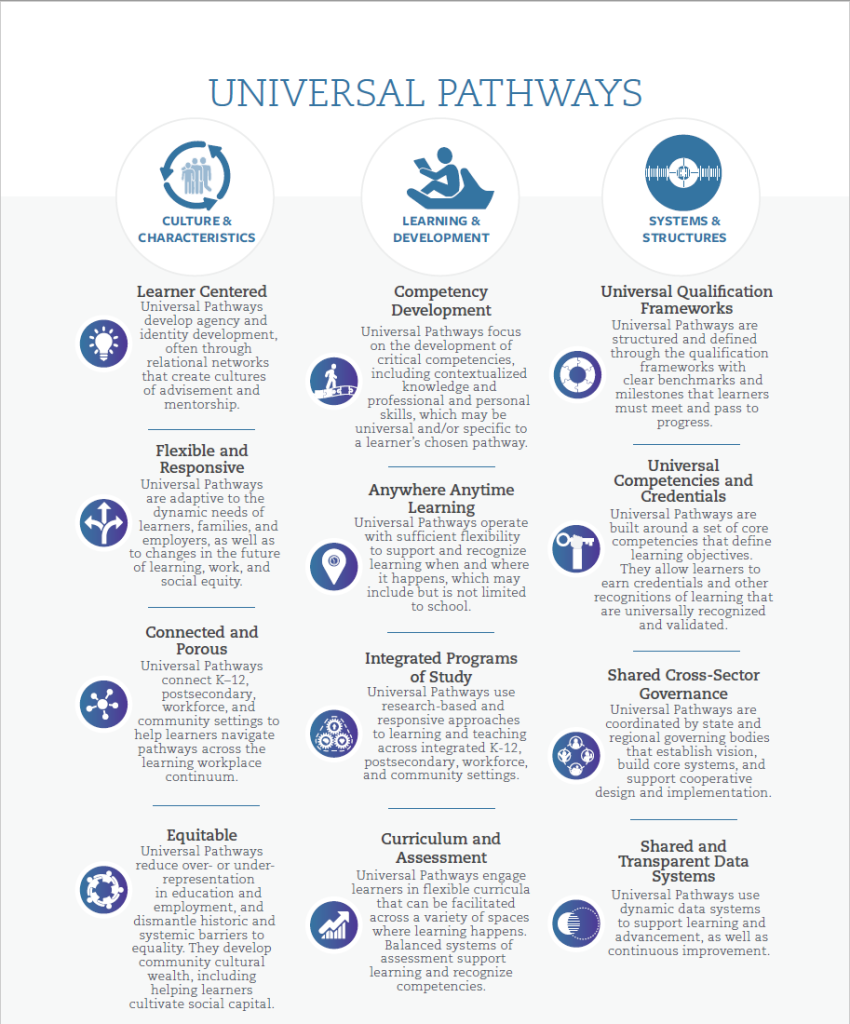
A system of universal pathways would articulate and certify multiple career pathways from K-12 through postsecondary education, career, and continuing education. Pathways would be transparent, universal, and recognized by schools and employers across the state. Each pathway would be defined by a progression of qualifying milestones and recognized credentials, which would certify that a learner has demonstrated a set of competencies across contexts and institutions on the basis of performance assessments. Coordination across K-12, postsecondary, workforce, and community would be enabled by a strong system of shared governance and dynamic, transparent data systems.
A system of universal pathways would focus on the development of critical competencies that support learners’ personal, professional, and academic development. It would recognize and support learning when and where it happens using balanced systems of assessment to evaluate and reward deep learning. It would prioritize cultural competency and align teaching with the learning sciences.
This self-assessment tool helps leaders assess current readiness and practice and then work with their teams and technical assistance partners to choose areas for highest impact.
This resource is intended to help school and district leaders understand, reflect upon, and prioritize actions to improve student learning in remote settings. This discussion guide highlights specific school-based “Power Moves,” examples and resources, and supportive system conditions that are particularly critical to ensuring high-quality teaching and learning in distance and online environments for all students.
As school districts deliberate over reopening schools with the COVID-19 pandemic still ongoing, we’ve developed this report with strategic guidance on how to harness our current opportunity to transform K-12 education.
Education Policy Issues for the COVID-19 Era: Policy Actions and Responses to Leverage the Moment for Future Readiness offers insights and recommendations on 10 critical issues identified through our technical assistance in the field and work with education policy decision-makers around the country. These include:
Using Blended, Competency-Based Learning as an Entry Point for Innovation
Moving Away from Seat Time Credits to Awarding Credit Based on Demonstrated Mastery
Re-Examining Grading Policies
Rethinking Assessment and Addressing the Need for Balanced Systems of Assessments to Measure Student Learning
Examining the Purpose of Accountability
Creating Flexibility and Multiple Pathways for Graduation Requirements
Ensuring All Communities Have the Necessary Technology Infrastructure and Internet Access
Supporting Students with Disabilities
Ensuring Students Have Continued Access to Meals during School Closures
Prioritizing Future Readiness for Pandemic Preparedness and Continuity of Learning
Building the capacity for educators to redesign toward a competency-based, learner-centered system is no easy task with the challenges imposed by the COVID-19 pandemic. Education Policy Issues for the COVID-19 Era concludes with a 10-point program with principles that lay the groundwork for the reforms our system urgently needs.
This website describes specific “Quality-Plus Teaching Strategies,” such as non-verbal representation, as identified and developed by Gwinnett County Public Schools. These evidence-based pedagogical strategies are focused on specific classroom practices that ideally lead to optimal student learning.